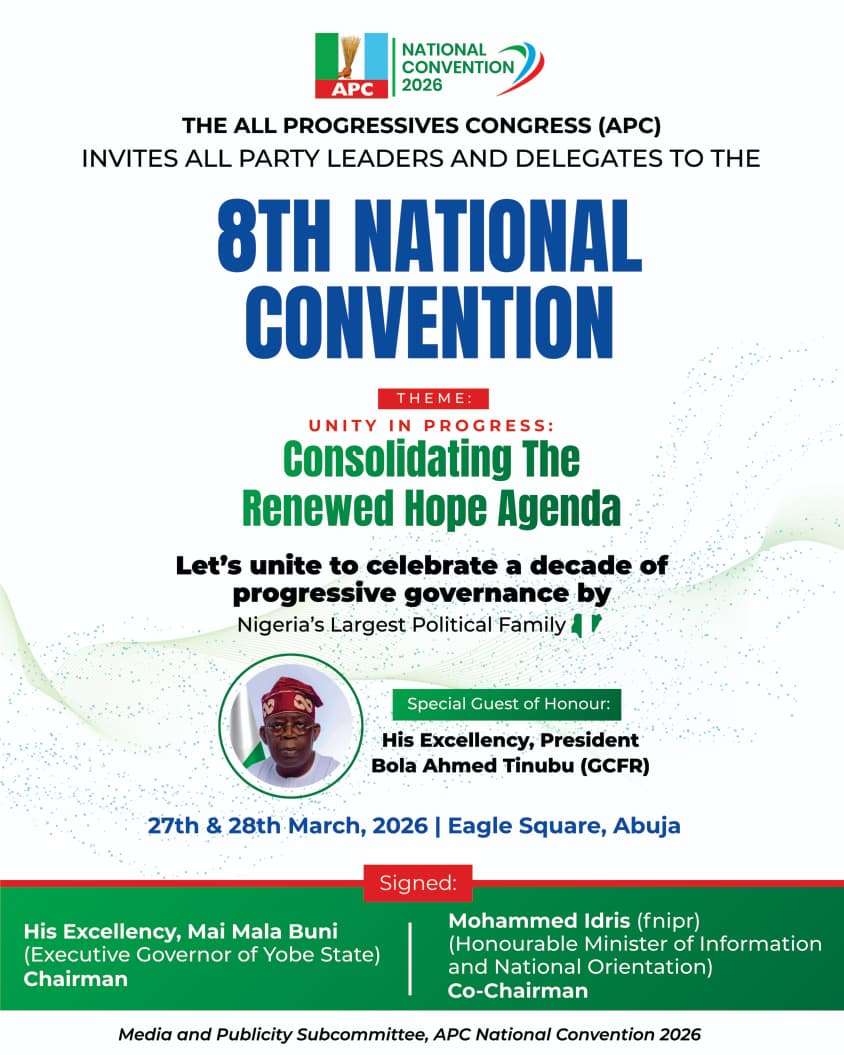
From all indications, the numerous political parties that have shaped Nigeria’s political landscape since the return to democratic rule in 1999 remain very much active and relevant. As far as I am aware, no fewer than twenty-two (22) political parties have successfully conducted congresses from the local government level up to the states, while some have also gone ahead to hold their national conventions without obstruction.
Indeed, within the past three months alone, a new political platform, the National Democratic Congress (NDC), has emerged under the leadership of a former Bayelsa State governor who is now a serving senator, Seriaki Dickson. At the same time, previously dormant fringe parties such as the APM have been revived by influential political figures like Seyi Makinde, a leading figure in a faction of the People’s Democratic Party (PDP).
Against this backdrop, the narrative being pushed by those predicting the collapse of democracy in Nigeria appears exaggerated and unfounded. The evidence on the ground strongly suggests that multi-party democracy remains vibrant and functional in the country.
Consequently, politicians and commentators who attempted to portray Nigeria’s democracy as being on the verge of extinction—largely in a bid to inflame the political atmosphere and advance their presidential ambitions by turning public opinion against the ruling APC—have increasingly been exposed as promoters of misinformation.

To me, the current level of political activity across Nigeria demonstrates the exact opposite of the doomsday predictions being circulated. With at least 22 political parties mobilizing supporters, organizing congresses, and preparing for the 2027 elections from the grassroots to the national level, it is clear that the country’s democratic space remains active and competitive.
The lesson Nigerians should take from this is that many self-styled political analysts have become little more than echo chambers for politicians seeking to manufacture tension and uncertainty for selfish political gain. Rather than objectively evaluating developments, some have amplified alarmist narratives suggesting that “there is fire on the mountain,” largely because certain political actors are beginning to realize that achieving power through open and competitive elections may prove difficult.
As a result, these actors appear determined to muddy the political waters.
Nigerians must also recognize a recurring pattern in politics: when some political actors sense that events are no longer moving in their favor, they often attempt to destabilize the system itself.
Some of those who now present themselves as Nigeria’s destined saviors have spent the last eight years moving restlessly from one political platform to another, much like butterflies hopping from flower to flower, yet they have failed to secure their ambitions. Faced with this reality, they now appear to have resorted to creating fear and tension by claiming—without credible evidence—that multi-party democracy in Nigeria is under threat.
One of their major allegations has been that the ruling All Progressives Congress (APC) intends to engineer a situation in which the incumbent president, Bola Tinubu, would emerge as the sole presidential candidate in the 2027 elections. However, these accusations have largely rested on speculation and innuendo rather than verifiable facts.
In reality, the existence of 22 registered political parties that have successfully submitted their membership registers to INEC in compliance with the Electoral Act 2026 tells a very different story.
Furthermore, INEC’s decision to extend the submission deadline demonstrated inclusiveness rather than exclusion. The extension accommodated parties that had become entangled in litigation and were therefore unable to meet the original deadline. Had the electoral commission refused to adjust the timetable, critics might have had stronger grounds for suspicion. Instead, INEC responded pragmatically by granting affected parties additional time and flexibility.
Viewed from this perspective, the claims that the 2027 elections are being manipulated to produce a sole candidacy for President Tinubu now appear increasingly hollow. The unfolding political developments have exposed such predictions as exaggerated attempts to create distrust and anxiety within the political system.
In essence, those promoting the gloomy narrative that democracy was on the verge of collapse under the administration of President Bola Tinubu have increasingly been exposed as alarmists motivated by mischief, selfish interests, or a combination of both.
The clearest proof that multi-party democracy remains alive and vibrant in Nigeria is the current wave of political activities involving the 22 political parties that successfully met INEC’s deadline for the submission of their membership registers
What has particularly worried me, however, is the quality of opposition politics in the country today. Rather than presenting Nigerians with coherent alternative policies and programs capable of competing with those of the incumbent administration, many opposition leaders appear more preoccupied with blackmail, sensationalism, and other counterproductive tactics.
My concern is that, instead of positioning themselves as credible alternatives with stronger ideas and better governance strategies, some opposition politicians—whose parties have become weakened by internal crises and a lack of internal democracy—have chosen to create panic and tension within the political space in order to tarnish the system itself.
Consequently, this crop of politicians, whom some commentators have mockingly described as “Internally Displaced Politicians” (IDPs), seem more focused on stirring anxiety within the polity whenever events do not favor them, rather than confronting the ruling APC through persuasive arguments, facts, figures, and innovative political strategies capable of winning public support. In doing so, they have arguably failed the very followers who look to them for leadership.
Ironically, the opposition was far more energetic and strategic when the APC itself was still outside power than what we are witnessing from today’s opposition leaders, many of whom now appear to expect the ruling party to create room for them to thrive politically. Yet politics has never been an arena governed by benevolence or charity.
A striking example can be found in the United States, where President Donald Trump has actively supported efforts to deny re-election to Republican lawmakers who backed his impeachment. One notable casualty has been Senator Bill Cassidy of Louisiana.
In politics, such actions are often regarded as “payback.”
Cassidy’s political setback reflects a broader trend involving Republicans who voted to convict or impeach Trump in 2021. He was among the seven Republican senators who broke ranks against Trump.
During Louisiana’s Republican Senate primary held on May 16, 2026, Cassidy reportedly finished third with 24.8 percent of the vote, while Trump-backed candidates—Congresswoman Julia Letlow and State Treasurer John Fleming—advanced to the runoff election scheduled for June 27.
Expectedly, Trump celebrated the outcome publicly, declaring that Cassidy’s “disloyalty” had effectively brought his political career to an end.
Viewed within this broader context, political developments in Nigeria—where certain aspirants in states such as Rivers, Ogun, and Lagos have allegedly been edged out during party primaries—are hardly unusual. Similar political maneuvering occurs in many democracies around the world, including the United States.
Indeed, the ruthless nature of politics often turns it into a survival contest. Trump, for instance, has made supporting challengers against Republicans who opposed him a central element of his post-2021 political strategy, and by most accounts, he has achieved considerable success with it.
Against that backdrop, it becomes difficult to understand why some critics are outraged over allegations that President Tinubu may be backing Obafemi Hamzat, the current deputy governor of Lagos State, as a possible successor to Babajide Sanwo-Olu in 2027. Similarly, critics have accused Federal Capital Territory Minister Nyesom Wike of using his political influence to marginalize Rivers State Governor Sim Fubara and his supporters during party primaries.
The unfolding political drama in the United States is relevant because Nigeria’s presidential system was modeled after the American system. Consequently, events in both countries reveal how fiercely competitive and often unforgiving politics can be, regardless of whether it is taking place in Washington or Abuja.
Ultimately, politicians are not saints or clergy, and moral idealism is rarely their defining attribute. Politics, by its very nature, often revolves around strategy, manipulation, blackmail, and intrigue. After all, politics has long been described as war conducted without weapons.
Indeed, the political atmosphere currently unfolding in Nigeria as preparations for the 2027 elections intensify reminds me of the biblical account in which the wisdom of King Solomon was put to the test
According to scripture, Solomon earned his reputation as the wisest king through the manner in which he resolved a tragic dispute between two women claiming ownership of a surviving baby after the other child had died due to the negligence of one of the mothers. Solomon proposed that the surviving child be divided into two, and the woman who agreed to such a suggestion immediately exposed herself as the impostor, since no real mother would consent to the death of her own child. Through that extraordinary display of wisdom, Solomon was able to identify the true mother.
In much the same way, the conduct of some Nigerian opposition figures today appears revealing. Faced with deep internal crises caused largely by the absence of internal democracy within their parties, many of them seem to have chosen to attack and delegitimize Nigeria’s democratic process itself, perhaps in anticipation of a likely re-election victory for the incumbent administration.
All things being equal, the prospects of President Bola Tinubu securing a second term appear increasingly strong, particularly given that the ruling APC currently controls 31 out of Nigeria’s 36 states.
Admittedly, opposition enthusiasts are correct in arguing that control of many states does not automatically guarantee electoral victory. Nevertheless, political control at that scale carries enormous strategic advantages. Governors, ministers, legislators, local government officials, advisers, and party loyalists at both national and sub-national levels collectively command extensive grassroots networks. Naturally, many beneficiaries of such political structures are inclined to support the ruling party at the polls.
As Steven Pressfield once observed:
“Fear is good. Like self-doubt, fear is an indicator. Fear tells us what we have to do.”
Unfortunately, in the case of Nigeria’s opposition parties, fear seems to have produced panic and political distraction rather than innovation and strategic thinking. Instead of retreating to their political drawing boards to formulate stronger alternatives to Tinubu’s political machinery, many appear consumed by scaremongering and red-herring tactics aimed at discrediting2027 elections before they even occur.
This situation also recalls the wise counsel of Epictetus, who warned:
“If you are careless and lazy now and keep putting things off… you will not notice that you are making no progress.”
That observation seems especially relevant to the current state of the opposition in Nigeria, particularly the People’s Democratic Party (PDP), once the dominant ruling party at the center. Over time, the PDP appeared unable to recognize the extent to which indiscipline and prolonged internal crises were eroding its political strength, much like a boa constrictor slowly suffocating its victim.
As the party’s leadership watched helplessly, the PDP’s dominance steadily declined—from controlling 25 states in 2011 to 23 before the 2015 elections, and eventually falling to 13 states after the 2015 elections, excluding states such as Oyo and Bauchi. Since then, even the PDP governors of Bauchi and Oyo have drifted into or formed alliance with smaller political platforms.
Rather than confronting their internal weaknesses through discipline, reform, and adherence to party rules, many opposition figures chose instead to defect from one platform to another under the assumption that “the grass is greener on the other side.” Yet they soon discovered that political defections can amount to moving from one crisis into another, as rival factions within their new political homes were already waiting with metaphorical long knives in the form of lawsuits and internal conspiracies aimed at frustrating their presidential ambitions.
Instead of engaging in honest self-reflection, they shifted blame yet again by accusing elements within the ruling party of fueling crises in the opposition. Their main evidence appeared to be that President Tinubu and his Chief of Staff, Femi Gbajabiamila, occasionally mocked opposition parties over their internal disarray.
If such comments constitute the strongest evidence of sabotage, then the accusation itself appears rather weak.
Before advancing claims that the ruling party was sponsoring instability within opposition ranks, many opposition figures had earlier alleged that the Economic and Financial Crimes Commission (EFCC) was being weaponized against them. However, lacking compelling evidence, those accusations failed to gain traction with the public. Consequently, the narrative quickly shifted toward another allegation—that the APC intended to transform Nigeria into a one-party state.
Yet INEC’s own announcements have demonstrated that no fewer than 22 political parties are preparing to contest the 2027 elections. To many objective observers, this clearly suggests that the opposition was largely crying wolf where none existed.
The Ibadan opposition political summit of April 25 initially created the impression that opposition parties had finally awakened from their slumber by agreeing to unite behind a single presidential candidate to challenge President Tinubu. However, what first appeared to be the birth of a formidable opposition alliance soon degenerated into a political anticlimax.
What looked like a potentially powerful coalition collapsed almost immediately like a house of cards.
The reason, in my opinion, lies largely in personal ambition and political ego. Virtually every major opposition figure who gathered in Ibadan harbors presidential ambitions for 2027.
This sharply contrasts with the events of 2013, when four opposition parties merged to form the APC and ultimately defeated the PDP in 2015. At the center of that coalition-building effort was then-Senator Bola Tinubu, who at the time was not directly pursuing the presidency for himself. Instead, he focused on supporting the candidacy of Muhammadu Buhari in 2015 while possibly positioning himself for a future presidential run after Buhari’s eventual exit in 2023—a strategy that ultimately succeeded.
That distinction is critical. The 2013 opposition coalition was driven by a broader collective objective, whereas many of today’s opposition leaders appear primarily motivated by personal presidential ambitions. Consequently, none of them seems willing to subordinate individual interests for the sake of a united opposition front.
As a result, the initiative unraveled because none wanted to become merely a facilitator for another politician’s ambition—in other words, no one wished to play the role of a “useful idiot.”
Nonetheless, given the level of political activity currently taking place across at least 22 parties preparing for the 2027 elections, the claim that Nigeria is drifting toward a one-party state has once again been exposed as an exaggerated political narrative designed to create instability and public anxiety.
Ironically, those promoting that narrative appear once again to have been politically outmaneuvered by President Tinubu, whose strategic approach continues to dominate Nigeria’s political landscape.
In my view, considering the intensity of political mobilization now underway across multiple parties and platforms, Nigeria’s multi-party democracy has rarely appeared more vibrant than it does today.
The justification for the assertion above can be found in recent developments within Nigeria’s political landscape.
According to INEC’s press release issued last Friday, all 22 registered political parties successfully submitted their membership registers, thereby fulfilling the requirements stipulated in the Electoral Act 2026.
The submissions were completed on May 8, two days ahead of the extended May 10 deadline. It may be recalled that INEC granted the extension after political parties expressed concerns during a meeting held on March 24. The original deadline had been fixed for April 21 before it was shifted to May 10 to allow parties additional time to compile their registers and conduct party primaries.
Had INEC refused to extend the deadline, it might have raised legitimate concerns about fairness and inclusiveness, especially for parties entangled in litigation and internal disputes that hindered their ability to meet the initial timeline. By adjusting the schedule, however, the electoral commission demonstrated a measure of flexibility and sensitivity toward the affected parties.
Now that the hurdle of submitting membership registers has been crossed, political parties have moved fully into the next phase of the electoral process. Primaries scheduled between April 23 and May 30, 2026, are already underway, and political activities across the country have intensified considerably.
Indeed, politics has become the dominant national preoccupation, with campaigns gathering momentum nationwide. The complaints of aspirants who lost primaries, alongside the celebrations of those who emerged victorious, are all part of the normal dynamics that characterize a functioning multi-party democracy.
Against this backdrop, it is difficult to argue that multi-party democracy in Nigeria is under threat. If anything, it appears active and robust, despite the pessimism of its critics.
For the sake of transparency, I have consistently been critical of what I consider the underwhelming performance of the current opposition parties and their leadership.
In an article titled “First-Class Politicians Playing Second-Hand Politics,” published in 2025 following the emergence of the African Democratic Congress (ADC) coalition against President Bola Tinubu ahead of the 2027 elections, I argued that Nigeria was witnessing the spectacle of “first-class politicians operating on a second-hand platform.”
Among the prominent political figures I identified were:
1. Atiku Abubakar — former Vice President and serial PDP presidential candidate.
2. David Mark — former Senate President and former military governor under the Babangida administration.
3. Nasir El-Rufai — former FCT Minister and former Kaduna State governor.
4. Rotimi Amaechi — former Rivers State governor and former Minister of Transportation.
5. Peter Obi — former Anambra State governor and Labour Party presidential candidate in 2023.
6. Babachir Lawal — former Secretary to the Government of the Federation under Buhari.
7. Goodluck Jonathan — whom I initially described as operating quietly behind the scenes, but who has since reportedly become more openly associated with fresh political permutations.
My argument at the time was that these were highly experienced and influential political actors, yet they were relying on recycled strategies and repackaged political platforms rather than introducing fresh ideas or transformational politics. Hence, I described their approach as “second-hand politics” aimed at unseating Tinubu in 2027.
Several months later, I must admit that the opposition has done little to disprove that assessment. Instead of evolving into a more strategic and cohesive force, it has appeared politically flat-footed as the 2027 election cycle steadily approaches.
One of the central points I made in that earlier article was that many opposition leaders seemed motivated more by the loss of political relevance and access to power than by a compelling ideological alternative. While they unquestionably have the democratic right to seek power, I argued that they would need superior organization, strategy, and messaging if they hoped to defeat an incumbent administration.
I also warned that Nigerians risked being confronted once again by “a recycled pool of politicians”—essentially familiar faces operating under new banners.
In that context, I suggested that Peter Obi risked becoming a serial presidential contender by moving from the Labour Party to the ADC and subsequently toward the newly formed National Democratic Congress (NDC), much like Atiku Abubakar, who has repeatedly contested for the presidency under the PDP banner since 2007.
In a follow-up article published on July 31, 2025, I employed the metaphor of “chess versus checkers” to explain the contrast between the APC’s political strategy and that of the opposition coalition.
My argument was that while Tinubu and the APC were engaged in long-term strategic planning—playing chess—the opposition coalition was reacting tactically and emotionally, effectively playing checkers with outdated methods.
I further argued that Nigeria’s political elite had become trapped in a cycle of “permanent campaign mode” and “political musical chairs,” where the same political actors rotate endlessly between parties and offices while governance outcomes remain largely unchanged.
In the article titled “Election 2027: While ADC Is Playing Checkers, APC Is Playing Chess,” I referenced the famous observation by Niccolò Machiavelli:
“One must be a fox to recognize traps, and a lion to frighten off wolves. Those who simply act like lions are stupid.”
Within that framework, I portrayed Tinubu and the APC as the “fox”—carefully calculating and strategically positioning themselves for 2027—while many opposition figures resembled the “lion,” loud and confrontational but lacking long-term tactical depth.
I also noted that the APC appeared focused on consolidating institutional power and building structures for the future, while much of the opposition remained reactive and publicly theatrical.
Looking back, the analogy still appears fitting. The opposition has unfortunately done little to challenge my earlier pessimism regarding its strategic capacity.
Since the ADC became a political vehicle for several defecting PDP leaders, I have consistently maintained that the opposition today appears weaker and less organized than the APC was when it occupied the opposition benches before 2015.
In my view, one of the best opportunities Peter Obi had to eventually reach Aso Rock may have been in 2019, had he reached a strategic understanding with Atiku Abubakar under a one-term arrangement that could have paved the way for Obi to succeed him.
Similarly, that same period arguably represented Atiku’s strongest opportunity to transition from vice president to president.
However, personal ambition and political ego appear to have prevented both men from reaching such a compromise.
Current reports suggesting that Obi and Rabiu Kwankwaso, the NNPP’s 2023 presidential candidate, may now work together under the NDC banner in 2027 are certainly politically noteworthy Yet, in my opinion, the most strategically advantageous moment for such an alliance may already have passed.
That partnership would arguably have carried far greater momentum in 2023. At the time, however, questions of hierarchy and political seniority reportedly stood in the way, with Kwankwaso allegedly unwilling to accept a subordinate role despite Obi’s rising popularity.
What appears to have changed since then is that political realities may now be forcing a reconsideration of positions that were once rejected.
Even so, I suspect that any Obi–Kwankwaso alliance may ultimately prove more consequential for 2031 than for 2027, largely because the political momentum that existed in earlier years has weakened and time is no longer on their side.
By the same reasoning, outgoing Oyo State Governor Seyi Makinde, who has also signaled presidential ambitions under his faction of the PDP aligned with the APM, may likewise be positioning himself more strategically for 2031 rather than 2027.
Makinde had contested for elections multiple times before he eventually succeeded. He might have adopted the strategy of trying many times before succeeding which was perfected by Winston Churchill ex prime minister of Britain who famously failed to win six (6) elections but remained tenacious until he finally succeeded.
From that perspective, some of the current maneuvering within the opposition may be less about immediate victory and more about long-term positioning for a post-incumbency political landscape in which the ruling APC could eventually become more vulnerable without the advantages of incumbency.
In conclusion, Nigeria is certainly not descending into one-party-state.
Magnus Onyibe, an entrepreneur, public policy analyst, author, democracy advocate, development strategist, an alumnus of the Fletcher School of Law and Diplomacy, Tufts University, Massachusetts, USA, a Commonwealth Institute scholar, and a former commissioner in the Delta State government, sent this piece from Lagos.
Stay ahead with the latest updates! Join The ConclaveNG on WhatsApp and Telegram for real-time news alerts, breaking stories, and exclusive content delivered straight to your phone. Don’t miss a headline — subscribe now!