

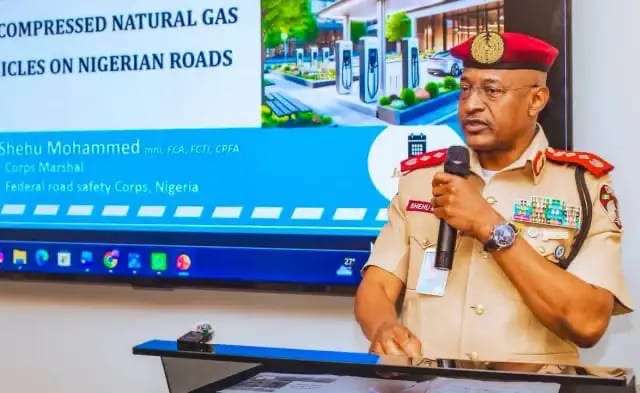
The National Design and Development Council (NADDC), Federal Road Safety Commission (FRSC) and key figures in the automotive industry and road sector stormed Lagos to push massive electric vehicles
(EV) and CNG expansion Thursday.
What everyone was saying at the third Nigeria Auto Industry Summit (NAISU), organised by the Nigeria Auto Journalists Association (NAJA)
is that
Nigeria’s clean mobility drive gains have improved.
The summit was themed, “Nigeria’s Clean Mobility Future: The EV and CNG Journey under the President Bola Ahmed Tinubu Administration.”
It was safe for
Corps Marshal, the FRSC, Shehu Mohammed to bring safer road issues to the front burner.
Mohammed expressed his concern
over the increasing rate of “reckless driving and traffic violations” in the Federal Capital Territory (FCT) despite the ongoing investments in road infrastructure. He
warned that the trend poses a serious threat to road safety.
“It is a concern to us. The driving culture in Abuja is worrying. There has been massive expansion of roads, but our personnel strength and logistics have remained the same. We simply do not have enough officers to man every road and traffic point,” he said.


He pointed out that reckless driving has continued to undermine efforts to reduce crashes and fatalities.
What happened is, Mohammed was responding to comment from a member of the audience who raised the concerns about increased traffic violations by motorists especially the elites in the federal capital territory.
However,
Mohammed said the Corps remains committed to achieving a safe and sustainable transport system by 2030, in line with global road safety targets.
According to him, road safety cannot be achieved through enforcement alone, urging motorists and other road users to take greater responsibility for safe driving.
“Road safety is a collective and shared responsibility. FRSC cannot do it alone. When crashes occur and lives are lost, it is not only the victims that suffer; the entire economy is affected,” he said.
The Corps Marshal also harped on the need for improved road infrastructure, noting that standard roads should be equipped with guardrails, road markings and traffic signs to enhance safety.
He lamented that road signs are often vandalised or stolen, making it more difficult to regulate traffic and guide motorists.
“Every standard road must have guardrails, proper road markings and road signs. Unfortunately, when aluminium road signs are installed, some people remove them,” he said.
Mohammed tasked government agencies on stronger collaboration, saying that no single institution can effectively address road safety challenges in isolation.
“We need synergy between government agencies. No organisation should work in silos. We must continue to share knowledge, competencies and resources to improve road safety.”
He was able to speak on the topic of the day, restating the FRSC’s support for cleaner transportation, describing electric vehicles (EVs) and compressed natural gas (CNG)-powered vehicles as important components of Nigeria’s transition to sustainable mobility.
The Corps, he said, is working with relevant agencies to develop standard operating procedures for the safe deployment and operation of EVs and CNG vehicles across the country.
According to him, while electric vehicles offer environmental benefits, they also present unique safety challenges, including battery thermal runaway, fire risks after severe collisions, electric shock hazards during maintenance and charging, and the complexities of extinguishing battery fires.
He advised EV owners to use only certified charging equipment and avoid overcharging batteries to reduce safety risks.
On CNG vehicles, Mohammed noted that the fuel is stored under high pressure and therefore requires strict adherence to safety standards during installation, maintenance and operation. The Corp Marshal called on citizens to make use of the Corps’ mobile application which allows members of the public to interact directly with the agency and access a range of digital services.








, Federal Road Safety Commission (FRSC) and key figures in the automotive…)