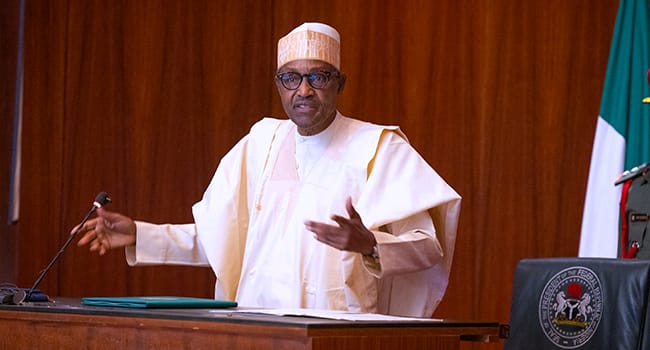
President Muhammadu Buhari on Thursday formally launched the 2022 Multidimensional Poverty Index (MPI) report.
Speaking at the event which took place at The Trascorp Hilton, Abuja, the President said the multidimensional way of understanding poverty has been helpful with highlighting beyond monentary/income-based poverty measurements, the stark realities of poverty in each State and across the 109 Senatorial districts.
He said according to the Report, the incidence of monetary poverty is lower than the incidence of multidimensional poverty across most States where 40.1% of people are poor according to the 2018/19 national monetary poverty line, but 63% are multidimensionally poor according to the 2022 Multidimensional Poverty Index (MPI) report.
He added that the Report shows that multidimensional poverty is higher in rural areas, where 72% of people are poor, compared to 42% of people in urban areas.
Globally, people that are most vulnerable to poverty are very often women and children.
The President said it is commendable to see that this Report also includes Child poverty numbers. Children are a strategic population of concern, as nearly half of all Nigerians are children under the age of 18. Two-thirds (67.5%) of children aged 0–17 are poor according to the National MPI, and half (51%) of all poor people are children.


He added that the government recognises the importance of these data and the need to engage a broad spectrum of stakeholders, both domestically and internationally. One way we have started this engagement was at the recent United Nations General Assembly where Nigeria co-hosted the Multidimensional Poverty Peer Network- MPPN and shared lessons-learned from other 100 member countries.
Full speech is reproduced below:
MR PRESIDENT’S SPEECH AT THE FORMAL LAUNCH OF THE 2022 MULTIDIMENSIONAL POVERTY INDEX (MPI) REPORT – HOLDING AT THE TRASCORP HILTON, 10AM, 17TH NOVEMBER 2022
PROTOCOLS,
1. Today, I am pleased to officially launch the 2022 Multidimensional Poverty Index (MPI) report. This is a Report that pinpoints the level of deprivations and its intensity that our citizens face. Beyond this, it also provides substantive evidence of the positive impact of the multi-sectoral interventions of this administration, especially during the COVID-19 pandemic, which demonstrated our commitment to eradicating extreme poverty, in Nigeria.
2. Ambassadors, Governors, Honourable Ministers, Distinguished guests, partners, and friends of Nigeria- we are acutely aware of global climate and environmental catastrophes, food and fuel crises, inflation, and austerity, exacerbated political and nuclear tensions, and the tiring weight of the COVID-19 pandemic. In such times as this, it would be easy to become faint hearted. It would be easy to turn aside from the poorest and most vulnerable, because resources are scarce, and a multitude of competing priorities call for our attention. However, today, as we gather here to launch the 2022 Multidimensional Poverty Index (MPI) report – I reaffirm our commitment to the first goal of the Sustainable Development Goals, which is eradicating poverty in all its dimensions.
3. You have heard directly from the people as captured in the documentary, our collective triumphs and struggles in understanding and untangling the interlinked deprivations that the poorest people experience. We have also heard as shared by the Honourable Ministers and partners, the endless possibilities of the transformative ways data from the MPI could be used for multisectoral policies to accelerate our efforts. It is my hope that with the report being launched today, every stakeholder will rise to the challenge, providing needed political leadership, strategic vision, and creative hard work to move the needle towards eradicating extreme poverty in Nigeria.
4. In 2019, as a government, we made a commitment to deploy the use of MPI in understanding poverty issues across multiple dimensions. This was at the United Nations General Assembly- UNGA, where the Federal Government announced the adoption of this global poverty measurement methodology to track the Presidential ‘100 million out of poverty’ mandate. Subsequently, the developers of the MPI- the Oxford Poverty & Human Development Initiative (OPHI), were invited to Nigeria in November of same year to discuss the modalities. In 2020, with the emergence of COVID-19, the economic fallout for Nigeria was particularly monumental, with visible pressure on the federal budget. What started as a health crisis- with grave impact on populations, also within months became a real economic crisis. The health crisis had real impact on education and food security, disrupted the large-scale humanitarian response to the conflict in the Northeast, and set back already stressed broader human development efforts. Given the multi-dimensional impact of the virus, and the challenge to protect the health of citizens (especially the most vulnerable), while at the same time guaranteeing sustainable recovery of national economies, livelihoods, and well-being after the crisis, the National Bureau of Statistics was commissioned to carry out a sub-national (Senatorial level) MPI survey, nationwide. It is for the success of this effort that we are here today officially launching the findings of the Report.
5. This multidimensional way of understanding poverty has been helpful with highlighting beyond monentary/income-based poverty measurements, the stark realities of poverty in each State and across the 109 Senatorial districts. According to the Report, the incidence of monetary poverty is lower than the incidence of multidimensional poverty across most States where 40.1% of people are poor according to the 2018/19 national monetary poverty line, but 63% are multidimensionally poor according to the 2022 Multidimensional Poverty Index (MPI) report. Furthermore, the Report shows that multidimensional poverty is higher in rural areas, where 72% of people are poor, compared to 42% of people in urban areas.
6. Globally, people that are most vulnerable to poverty are very often women and children. It is therefore commendable to see that this Report also includes Child poverty numbers. Children are a strategic population of concern, as nearly half of all Nigerians are children under the age of 18. Two-thirds (67.5%) of children aged 0–17 are poor according to the National MPI, and half (51%) of all poor people are children.
7. This Government recognises the importance of these data and the need to engage a broad spectrum of stakeholders, both domestically and internationally. One way we have started this engagement was at the recent United Nations General Assembly where Nigeria co-hosted the Multidimensional Poverty Peer Network- MPPN and shared lessons-learned from other 100 member countries. However, this is just the start. Internally, we have now deployed a comprehensive Data Demand and Use (DDU) strategy to embed the use of evidence-based and data driven poverty reduction mechanisms. To begin this deployment of the data, let me share seven reasons why Nigeria’s multidimensional poverty index is a powerful tool to galvanise the kind of action that will push us forward to achieving the Presidential mandate of lifting 100 million out of poverty, within the next decade:
a. First, the building blocks of Nigeria’s MPI are a set of deprivations that a person experiences at the same time. They relate to dimensions like health, education, living standards, work, and security. And so, the MPI brings under one roof different SDG indicators and forms of poverty, so we can break silos and address them together.
b. Secondly, Nigeria is a large and diverse country. Using the disaggregation to show the vast range in the levels of poverty, we can see the precise needs for each State or senatorial districts, which will allow policymakers at that level take appropriate action.
c. 3, as a post-pandemic data, it will be integrated within the National Social Register – the government’s largest databank on the poor and vulnerable. This integration will facilitate better targeting and coordinated response for social interventions; leaving no one behind.
d. 4, The MPI is embedded within the Medium-Term National Development Plans (2021-2026 & 2026-2030) as a measurement and policy tool for poverty reduction. Likewise, this year, the Federal Executive Council approved the 2022-2025 National Poverty Reduction with Growth Strategy (NPRGS) under which the MPI project is being implemented.
e. 5, The MPI analysis uncovers differences by gender and children. Children are a strategic population in Nigeria. They are deeply affected by poverty, yet they are our future. So, we are building a young child MPI. It includes the national MPI and adds in extra information about early childhood development, which is information we require to improve their lives and life chances.
f. 6, At the Federal level, these results will be used to influence the allocation of resources going forward, particularly to target sectors where most citizens suffer deprivations.
g. 7, The MPI is not our only data on poverty, combining the insights provided by MPI results with data from the income poverty measurement, it provides a holistic picture of poverty, and helps to shape the path towards shared prosperity.
8. Allow me at this juncture to reiterate my unwavering commitment to eradicating extreme poverty in Nigeria. Thus far, this has been evident by the official establishment of the National Social Safety Nets Coordinating Office (NASSCO) in 2016, which is the custodian of the National Social Register- the largest repository of the poor and vulnerable in Nigeria. Likewise, we consolidated the impact made in the lives of over 5 million persons with the implementation of the National Social Investments Programme (NSIP), by institutionalising it under the Federal Ministry of Humanitarian Affairs, Disaster Management and Social Development (FMHADMSD) in 2019. Hence, we have been intentional with our plan to lift 100 million people out of poverty within 10 years, in line with the objectives of the SDGs and the Africa Agenda 2063. We are happy that the MPI will serve as both a measurement and policy tool to monitor our progress at achieving these goals.
9. I want to recognise the efforts of the Steering committee of the National Poverty Reduction with Growth Strategy (NPRGS), chaired by His Excellency, the Vice President- Prof. Yemi Osinbajo, SAN, GCON; the leadership provided by the Honourable Minister of State, Budget, and National Planning- Prince Clem Agba; and the commitment of people at the National Bureau of Statistics. Lastly, I must thank our friends at the United Nations- UNDP and UNICEF, the High Commission of Canada to Nigeria, the Delegation of the European Union (EU) mission in Nigeria, and the Foreign Commonwealth and Development Office (FCDO), for the support offered for the successful delivery of this exercise.
10. Lastly, I urge everyone, Governors, policymakers, academics, private sector, the media, and the public, to engage with the results of this survey and find ways of utilising the findings to support the development in your respective areas. Together, we can work to eradicate extreme poverty in Nigeria, ensuring that we leave no one behind.
11. Thank you, and God bless the Federal Republic of Nigeria.