United States is set to review her assistance activities in Sokoto and Kebbi states.
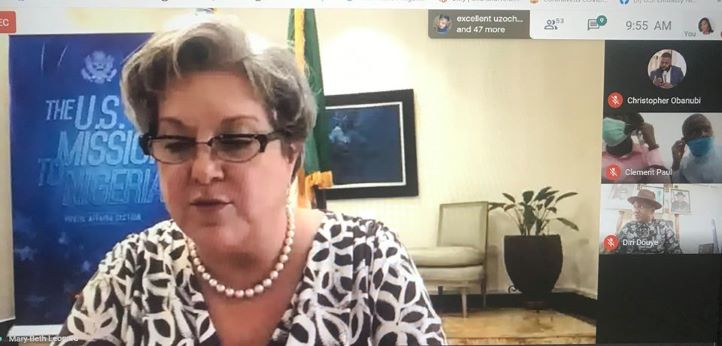
The U.S. Ambassador, Mary Beth Leonard and a delegation from the U.S. Mission had met between May 18 and 20 with government leaders, private sector and civil society representatives in Sokoto and Kebbi to discuss bilateral relations between the United States and Nigeria, and to exchange views on key issues such as security, health, education, economic development, and the COVID-19 response, and to review U.S. assistance activities in the two states.
During the Ambassador’s meeting with Governor Aminu Waziri Tambuwal of Sokoto State, she acknowledged the difficulties faced by Sokoto regarding regional insecurity and encouraged a focus on improving economic opportunity that will help improve citizens’ lives.
She said: “Insecurity is a difficult problem, but I don’t think it’s an insurmountable one,” adding that: “We encourage all citizens to contribute positively to prosperity and security of this country.”


The Ambassador, while in Sokoto also visited Bishop Matthew Kukah, head of the Roman Catholic Diocese of Sokoto, where she discussed interfaith efforts in the state, and discussed ways to build community and encourage youth civic engagement.
During her visit, the Ambassador met several U.S. government exchange alumni, and highlighted the impact they are making in Sokoto.
In a press briefing at the American Corner in Sokoto, the Ambassador noted that the United States provided $122 million to build capacity and support health care in Sokoto since 2015.
She also met with partners from the USAID-supported Nana Khadijat Sexual Assault Referral Center (SARC) to better understand the needs of survivors of gender-based violence, especially during the COVID-19 era.
The SARC delivers free medical, legal, and psychosocial services to survivors of violence.
The Ambassador during while in Kebbi State, discussed agriculture with the Governor, Sen. Abubakar Atiku Bagudu, who acknowledged the valuable support from the U.S. Feed the Future initiative, which has helped improve access to agricultural support services for women farmers.
In Argungu, Governor Bagudu joined the Ambassador to launch a new partnership with WACOT Rice, a leading Nigerian producer, at the firm’s rice processing factory. A $1.48 million grant through the USAID-funded West Africa Trade and Investment Hub leveraged an $8.6 million WACOT investment to bring 5,000 additional farmers – half of them women—into its Outgrower Expansion Project, which will modernize production enough to double rice yields and support economic growth in Kebbi and promote economic development. Outgrowers are farmers under contract to supply a specific processing firm.
Ambassador Leonard also visited Yahaya Abdulkarim Model Primary School, Wamakko, where she observed a reading lesson using “Mu Karanta!” (Let’s Read!) materials and techniques provided by the USAID Northern Education Initiative (NEI) Plus activity that was piloted in Sokoto and now includes an additional five states.
She lauded the state’s commitment to early grade reading by meeting its financial commitment to NEI Plus, and in so doing the example Sokoto has set for other states to follow suit. Over the last five years, NEI Plus also provided nine million schoolbooks, trained 9,500 teachers, and improved reading skills for nearly a million pupils.
She said of her trip, that: “It was wonderful to get a close-up look at U.S. government programmes in action and see their impact firsthand. I hope to visit again soon.”