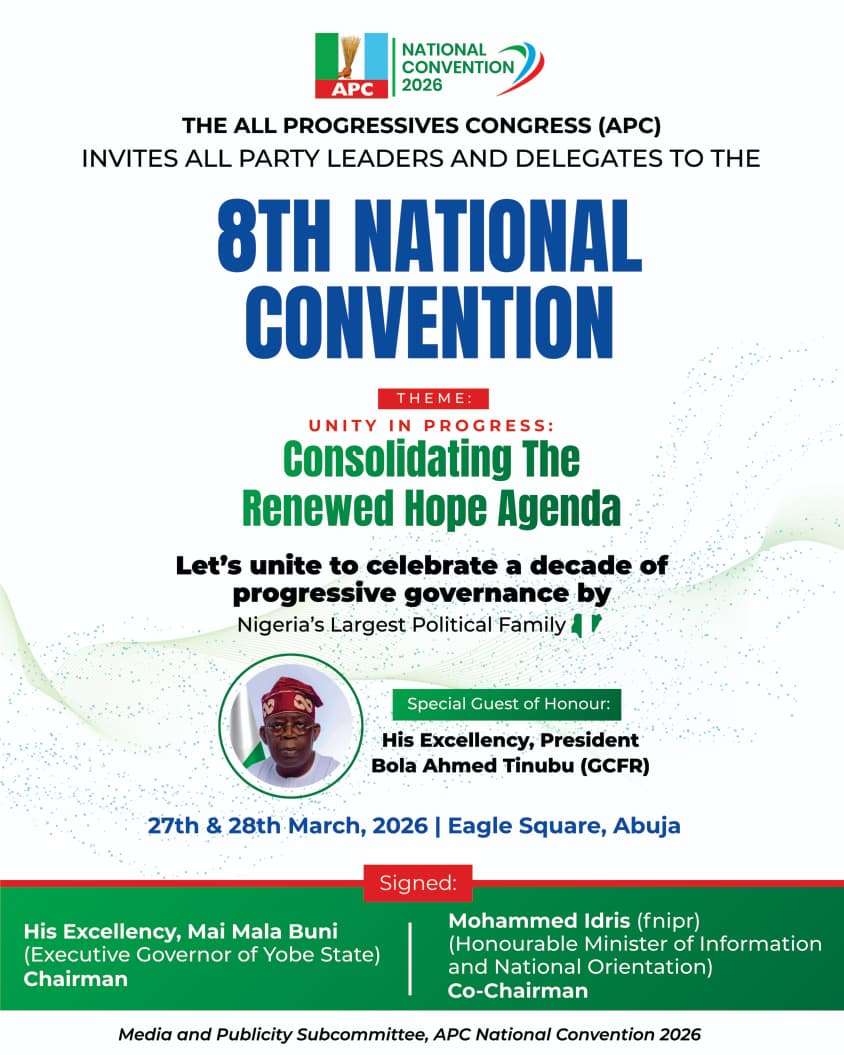
Many in the opposition camp are praying for – and predicting, post-primaries of the political parties for the 2027 General Election – an “implosion” of the behemoth ruling All Progressives Congress (APC) that controls 31 of 36 States of the Federation, and the Federal Capital Territory (FCT), Abuja, Nigeria’s capital city.
Chieftains of the Coalition of Opposition Politicians (COP), led by former Vice President and candidate of the main opposition Peoples Democratic Party (PDP) in 2019 and 2023, Alhaji Atiku Abubakar, have emphasised “implosion” of the APC, to prevent Tinubu from turning Nigeria into a “one-party state,” with former Kano State Governor Rabiu Musa Kwankwaso, the latest to predict the party’s doom.
Dr Kwankwaso, the 2023 presidential candidate of the New Nigeria Peoples Party (NNPP) and ex-Minister of Defence, has foretold the shattering of the APC aftermath of the political parties’ primaries fixed from April to May 2026 by the Independent National Electoral Commission (INEC).
Reacting to the defection of his son-in-law and Kano Governor Abba Kabir Yusuf to the APC, Kwankwaso, alleging that the governor “betrayed him, the Kwankwassiya Movement and Kano people,” said “disputes” were likely to emerge, causing division and (re)defection from the APC and (perhaps) opposition African Democratic Congress (ADC), as both have gained from alignments and realignments in the polity ahead of the 2027 poll.
In an interview with the BBC Hausa Service on January 28, 2026, Kwankwaso noted that Yusuf’s claims of internal crisis in the NNPP, and other reasons the governor gave for defecting “were issues that could have been resolved through dialogue and cooperation,” arguing that “no political party is completely free of grievances.”
“I can assure you, to the best of my knowledge, there is no party more peaceful and stable than the NNPP. And if there is any, let them hold their national convention and candidate selection processes, then you will see disputes,” he said.
While Kwankwaso’s warning may materialise after the primaries over alleged shortchanging of aspirants for party positions or the 2027 election, the APC and even the ADC should learn from PDP’s self-inflicted problems preceding the 2023 poll, and continue to fester, as the two factions calling the shots unable to access the party headquarters at the Wadata Plaza in Abuja.
With the Court of Appeal giving the factions a lifeline to reconcile their differences away from the courts in different jurisdictions, the leaders still talk tough amid recognition of the imperative to change course, to enable the party to field candidates for the 2027 election.
Pre and post-2023 General Election, the PDP had under its control 13 States and 11 States, respectively. But as of today (Monday, March 16, 2026), the party’s left with two states, as nine state Governors, along with majority of their members and structures, had defected to the APC between 2025 and 2026 – the latest decamping occurring a week ago, on March 9, 2026.
A look at the standings of political parties across the 36 States and the FCT, Abuja, in the six geopolitical zones of Nigeria, illustrates the odds stacked against the opposition members in their quest to “remove from power” President Tinubu and his APC-led administration in the scheduled poll for January and February 2027.
In the North-Central zone, the APC controls all six states of Benue, Nasarawa, Niger, Kogi, Kwara and Plateau, and five of six FCT Area Councils, while the PDP’s one council. In the North-East zone of six states of Adamawa, Bauchi, Borno, Gombe, Taraba and Yobe, the APC governs five states, with one state under the PDP. The APC controls the North-West zone of seven states of Jigawa, Kaduna, Kano, Katsina, Kebbi, Sokoto and Zamfara.
In the South-East zone of five states of Abia, Anambra, Ebonyi, Enugu and Imo, the APC superintends three states, the All Progressives Grand Alliance (APGA) one state, and Labour Party (LP) one state. The APC also rules the six South-South zone states of Akwa Ibom, Bayelsa, Cross River, Delta, Edo and Rivers. For the South-West zone of six states of Ekiti, Lagos, Ondo, Ogun, Osun and Oyo, the APC controls four states, the Accord Party (AP) one state, and the PDP one state.
In summary, the Accord Party controls one state of Osun; the APGA one state of Anambra; the APC 31 states of Adamawa, Akwa Ibom, Bayelsa, Benue, Borno, Cross River, Delta, Ebonyi, Edo, Ekiti, Enugu, Gombe, Jigawa, Kaduna, Kano, Katsina, Kebbi, Kogi, Kwara, Lagos, Nasarawa, Niger, Ondo, Ogun, Plateau, Rivers, Sokoto, Taraba, Yobe and Zamfara, and five FCT area councils; the LP one state of Abia; and the PDP controls two states of Bauchi and Oyo, and one FCT area council.
Although the ADC’s gained in numerical strength in the National Assembly (NASS) following defections of some lawmakers from the PDP and LP, and thus brags that it’s truly the “main oppostion” in Nigeria, the PDP, which controls two State Governorships and two State Houses of Assembly retains the tag of “main oppostion in Nigeria,” even as the ADC may assume the minority leadership in the NASS.
The question is: With the lopsided party configuration favouring the APC across Nigeria, how do the disparate opposition parties, with five states under their control, intend to upstage the party with 31 states during the 2027 election, first in the Presidential and National Assembly contest of January 16, and the Governorship and Houses of Assembly poll on February 6, 2027, accordingly?
Without doing the heavy lifting of intellectually and professionally dissecting and analysing the various socio-economic and political policies and programmes of the Tinubu administration, to expose their flaws, weaknesses, and consequences on the country and Nigerians, and offer credible and workable alternatives; the opposition parties mouth self-interest calls for a united front to challenge the seemingly octopodal APC at the ballot.
Lacking coherence, cohesion and coordination, the opposition that should resemble a “shadow government,” postures as if the “make or mar” 2027 election is a walk in the park. Members would rather engage in rhetoric, drama, propaganda and things ridiculous, such as invoking “patriotism” and subtle blackmailing of “Nigerians” they tout will vote against the APC, Tinubu and his administration, citing the hardship and suffering Nigerians experience from the president’s touch and punishing economic reforms instituted right from his inaugural venue on May 29, 2023.
As he reacted the other day to the defection to the APC of his home Governor Ahmadu Fintiri of Adamawa State, Atiku played up “Tinubu versus Nigerians” in the 2027 poll. A statement by his media office on February 28 partly reads: “Former Vice President of Nigeria and chieftain of the African Democratic Congress (ADC), Atiku Abubakar, has declared that the 2027 election will be a straight fight between Bola Tinubu and the APC on one side, and the Nigerian people on the other.
“Atiku warned that the wave of defections by opposition governors is not a sign of APC strength, but evidence of pressure and intimidation. He accused the Tinubu administration of weaponizing state institutions to bully political opponents in a desperate bid to turn Nigeria into a one-party state.
“Governors may defect for personal survival. Nigerians are defecting in their millions because they want survival. What will the APC campaign on in 2027 – hunger? hardship? hopelessness? Do not trade your future. Do not mortgage your children’s tomorrow. In 2027, the people will have their say – and their will shall prevail.”
Certainly! But definitely not the replacement of the incumbent with a vacuous opposition leadership, as Nigerians can’t reward politicians, who know not the actual meaning of “opposition,” its methodology and workings to replacing a ruling party for the benefit of the people, and not of the politicians using the people as cannon folders to gain power for their own aggrandisement.
In closing, let’s be clear: The APC may encounter problems in one or two of its state chapters, such as Cross River, where a former Governor and a serving Senator are reportedly at loggerheads over the senatorial ticket for 2027, and Benue State, where Governor Hyacinth Alia and Secretary to the Government of the Federation, Senator George Akume, appear recalcitrant to reconciliation despite appeals by President Tinubu.
There’ll be no implosion or the APC, and the opposition should look for other issues that may affect the party to lose power in 2027, as the dynamics haven’t changed despite the celebrated defections of several lawmakers from two opposition parties, the PDP and LP, to another opposition party, the ADC.
That’s more or less an “in-house movement” that adds nothing but a “bragging right” that the ADC’s become the “new opposition” in the polity, which doesn’t detract from the inevitable on ground: That the 2027 General Election is a done deal for the APC. The opposition should start planning for 2031!
• Mr Ezomon, Journalist and Media Consultant, writes from Lagos, Nigeria. Can be reached on X, Threads, Facebook, Instagram and WhatsApp @EhichioyaEzomon. Tel: 08033078357.
Stay ahead with the latest updates! Join The ConclaveNG on WhatsApp and Telegram for real-time news alerts, breaking stories, and exclusive content delivered straight to your phone. Don’t miss a headline — subscribe now!