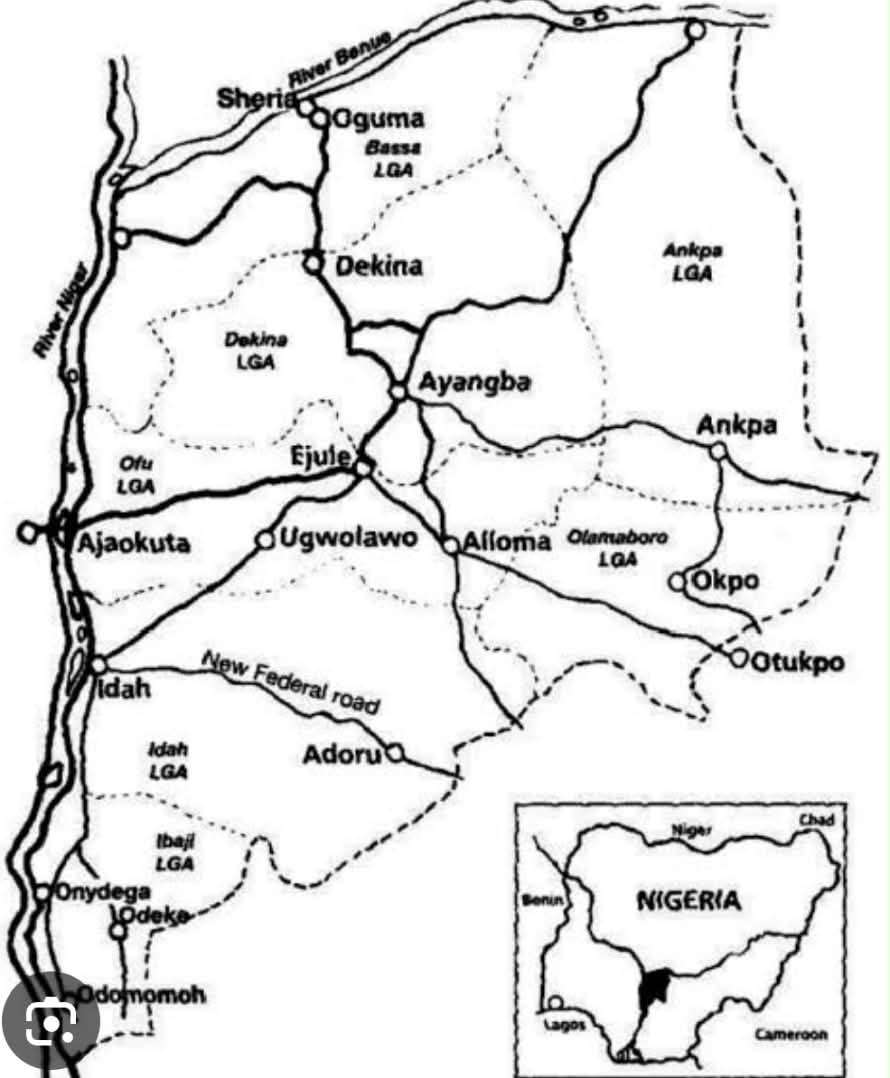
The agitation for an Ane-Igala state is not without justification. It is born out of a genuine sense of frustration, a perception of political marginalisation and, perhaps more importantly, a deep and understandable anxiety about the future of a people who believe they possess the human capital, numerical strength and cultural identity to command a more consequential place in the Nigerian federation.
But beneath the argument for a new state lies a more difficult question which the Igala nation must confront with courage and intellectual honesty: has the present political arrangement really been the principal obstacle to Igala prosperity, or have the Igala themselves failed to convert the considerable advantages they already possess into enduring political, economic and social capital?
That question may be uncomfortable, but it is unavoidable.
Kogi State has about 21 local government areas, depending on the administrative classification being referenced, with Kogi East accounting for nine of them. The East is also generally regarded as containing a majority of the state’s population. In other words, the Igala-speaking political bloc is not a powerless minority trapped in an overwhelmingly hostile political geography. It is a major, arguably decisive, component of the existing state structure.



For decades, therefore, the Igala have possessed something many ethnic groups in Nigeria desperately seek: numbers, territory, political consciousness, traditional institutions, an impressive pool of educated professionals and a long history of producing people who have occupied influential positions in government, the military, academia, business and the professions.
Yet the uncomfortable reality remains that these advantages have not translated proportionately into prosperity.
And that is where the conversation about Ane-Igala must become much deeper.
If nine local government areas, a substantial majority of the state’s population, considerable electoral strength and an impressive catalogue of distinguished sons and daughters have not produced the level of development expected, why should the creation of another administrative boundary automatically produce a different outcome?
A new state does not manufacture leaders.
It does not manufacture capital.
It does not manufacture roads.
It does not manufacture industries.
It does not manufacture accountability.
It does not eliminate corruption.
And, most importantly, it does not automatically change the political culture of the people who will inherit it.
This is the great intellectual gap in the state-creation argument.
There is a tendency in Nigeria to treat political geography as the solution to political failure. When development does not come, we create another state. When a state does not work, we create more local governments. When representation appears inadequate, we demand additional constituencies. The boundaries keep changing, but the underlying political behaviour often remains the same.
The Igala question should therefore not merely be, “Why are we in Kogi State?” It should also be, “What have we done with the enormous advantages we already possess?”
That is not an argument against Ane-Igala. It is an argument for intellectual seriousness.
For many years, Igala political discourse has been dominated by the language of marginalisation. Yet marginalisation cannot become a permanent explanation for every failure. At some point, a people must interrogate the quality of the leadership they have produced, the institutions they have built, the political bargains they have made and the priorities they have rewarded.
The Igala nation has produced governors, senators, ministers, ambassadors, generals, professors, permanent secretaries, business leaders, academics and other accomplished professionals. But what measurable transformation have these positions collectively produced in the ancestral homeland?
Where are the industrial clusters?
Where is the agricultural revolution?
Where are the world-class educational institutions?
Where is the organised indigenous investment architecture?
Where are the modern cities?
Where are the research and innovation centres?
Where are the enduring economic institutions that can survive individual politicians?
Where is the organised philanthropic structure capable of transforming communities rather than merely sponsoring ceremonies?
These questions are not indictments of the Igala people. They are an invitation to self-examination.
Indeed, perhaps the greatest tragedy is that a people celebrated for intelligence, education, courage, enterprise and excellence have too often allowed politics to become a contest over access rather than a mechanism for development.
The political class has sometimes reduced the immense possibilities of Igala society to elections, appointments, contracts, patronage and personal influence. Political thuggery, drugs, opportunism and the cultivation of local political jobbers have occasionally occupied spaces that should have been reserved for policy, ideas, entrepreneurship and institution-building.
The consequence is devastating.
A generation of young people is taught to see politics as the shortest route to survival rather than public service as the highest expression of citizenship.
The result is a society where political loyalty can become more valuable than competence, where proximity to power can become more profitable than innovation, and where the capacity to mobilise crowds can sometimes overshadow the capacity to design an economic future.
That is the crisis.
And it cannot be solved merely by drawing a new boundary on a map.
There is also another danger which advocates of state creation must confront honestly. A state created in the name of Igala unity may not necessarily produce Igala unity.
It could, in fact, produce an even fiercer struggle over who controls the new political centre.
Which senatorial zone produces the governor?
Which traditional institution becomes pre-eminent?
Which local government gets the capital?
Who controls appointments?
Who controls contracts?
Who controls the party structure?
Which clan gets the major institutions?
Who determines the distribution of resources?
The history of Nigerian state creation provides enough evidence to suggest that administrative separation does not abolish competition; it often relocates it.
Therefore, if the old political culture is carried into the new state, Ane-Igala could simply become a smaller theatre for the same struggles that have frustrated development in the larger Kogi arrangement.
That is why the most important Igala project today should perhaps not be state creation but nation-building within the nation.
The Igala people need a new social contract.
They need an intellectual compact between their traditional institutions, political class, professionals, business community, academics, religious leaders, young people and civil society.
They need to agree that development must become the central measure of leadership.
Not the number of appointments.
Not the size of political rallies.
Not the number of people transported to Abuja.
Not the volume of campaign posters.
Not the ability to defeat an opponent in an election.
The question should be brutally simple: what did your leadership do to improve the material condition of the Igala people?
This requires a cultural and economic renaissance.
The first pillar should be education. An Igala child should not need political connections to receive quality education. The community’s enormous intellectual capital should be organised into scholarships, research foundations, technology centres, vocational institutions and competitive academic programmes.
The second should be economic reconstruction. The Igala homeland possesses agricultural possibilities, riverine opportunities, mineral resources and strategic geographical advantages. What is missing is a coherent investment architecture capable of turning these resources into industries and jobs.
The third should be diaspora mobilisation. There are accomplished Igala professionals and entrepreneurs across Nigeria and around the world. Their relationship with their homeland should go beyond festivals, political meetings and donations. A serious investment network should connect Igala intellectual and financial capital to enterprises at home.
The fourth should be traditional and cultural emancipation. Culture should not be preserved merely as costume, dance and ceremonial pageantry. It should become an institution of identity, social discipline, historical consciousness and intergenerational transmission. The restoration of festivals, traditional knowledge, language, literature and historical scholarship should be treated as development projects.
The fifth should be political accountability. Igala society must stop rewarding political failure simply because the failed politician belongs to the same ethnic group. Ethnic solidarity without accountability is not patriotism; it is an invitation to mediocrity.
An Igala politician should be supported because he performs, not merely because he is Igala.
An Igala businessman should be celebrated because he creates wealth and jobs, not because he belongs to a particular political faction.
An Igala intellectual should be respected because he contributes ideas, not because he occupies a government appointment.
And an Igala traditional ruler should be valued not merely for his palace but for his capacity to preserve culture, reconcile society and inspire development.
The Igala are reputed to be the ninth-largest ethnic group in Nigeria. If that numerical strength is correct, then the real question is not simply how to convert that number into another state. It is how to convert that number into human capital, economic capital, intellectual capital and institutional power.
Population is potential.
Organisation converts potential into power.
Institutions convert power into prosperity.
This is the lesson that should define the next chapter of Igala history.
The Igala people do not need to apologise for demanding fairness. They should demand it. They do not need to abandon the aspiration for Ane-Igala if they sincerely believe a new state will advance their collective interest. But neither should state creation become a political jamboree that distracts from the more immediate work of rebuilding the society itself.
The constitutional and administrative process of creating a new state is notoriously complex, politically difficult and institutionally demanding. It requires broad consultations, legislative processes, boundary questions, political negotiations and ultimately a national consensus that cannot be wished away by passionate declarations.
It would therefore be dangerous to place the entire future of a people on a project whose success depends substantially on forces beyond their immediate control.
There is a more attainable revolution.
Build the schools.
Build the industries.
Build the farms.
Build the research institutions.
Build the cities.
Build the investment networks.
Build the cultural institutions.
Build a leadership culture that punishes mediocrity.
Build a political class that understands that power is a trust, not a trophy.
Build a generation that sees education, enterprise, science, technology and innovation as pathways to freedom.
And above all, build a consensus that transcends the perennial contest among Igala elites for political supremacy.
Perhaps then the argument for a separate state will acquire an entirely different meaning. It will no longer be an escape from failure; it will become the administrative expression of an already existing culture of competence, unity, productivity and institutional maturity.
The Igala nation has enough history to be proud of, enough intellectual capacity to be ambitious about, and enough human resources to build something remarkable.
What it needs now is not another generation of local champions whose greatest achievement is their proximity to power.
It needs builders.
It needs thinkers.
It needs entrepreneurs.
It needs patriots who can look beyond the next election.
It needs leaders who can see an Igala child born today and ask what kind of society that child will inherit thirty years from now.
That is the real meaning of leadership.
And perhaps that is the conversation that should precede Ane-Igala.
For the ultimate question is not whether the Igala can create a state.
The question is whether the Igala can create a society worthy of a state.
Abuja hotel workers reject unions as NLC, TUC begin picketing
If they can answer that question convincingly, the argument for Ane-Igala will become stronger, more credible and more difficult to dismiss.
If they cannot, a new state may merely provide a new address for an old problem.