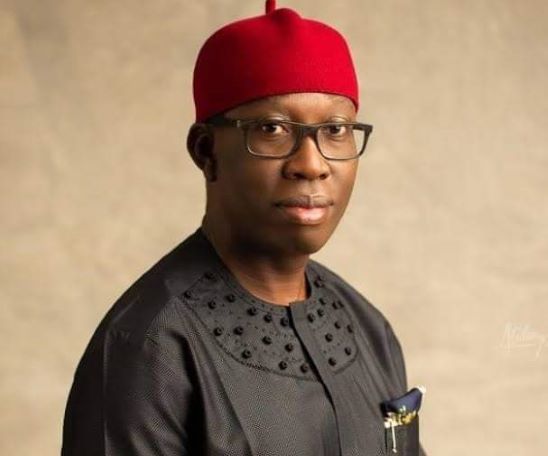
Wonders, as they say, shall never cease—and in the ever-fluid theatre of Nigerian politics, the script is constantly being rewritten. The name now echoing through the corridors of speculation and intrigue is that of Ifeanyi Okowa, a man whose political journey appears far from its final chapter.
Whispers growing louder by the day suggest that the former Governor of Delta State and erstwhile running mate to Atiku Abubakar in the 2023 presidential election may be perfecting plans for a return to the Senate in 2027. But this is no ordinary comeback bid. Beneath the surface lies a deeper, more audacious ambition—a calculated push for the exalted office of Senate President.
For Okowa, this would not be unfamiliar terrain. Between 2007 and 2011, he served as a senator, carving a niche for himself and even chairing the Senate Committee on Health. Yet, like many Nigerian politicians whose trajectories are shaped by both opportunity and timing, he pivoted to executive leadership, securing the governorship of Delta State and serving two full terms. His years as governor were marked by a blend of administrative experience and political expansion, widening his influence beyond the creeks and cities of his home state into the broader national landscape.
Then came 2023—a defining moment. His emergence as the vice-presidential candidate of the People’s Democratic Party was both strategic and controversial. While it signaled trust from the party’s leadership, it also ignited internal fractures. Some powerful blocs within the PDP viewed his selection as a miscalculation, one that deepened existing fault lines within the party. The aftermath of that decision, many argue, still lingers like an albatross around the PDP’s neck.


Following the electoral defeat, the tides turned swiftly. The Economic and Financial Crimes Commission cast its investigative gaze on Okowa’s tenure as governor. Allegations surfaced—most notably, claims that billions of naira from Delta State resources were funneled into the vice-presidential campaign. Though these accusations remain part of an ongoing narrative of scrutiny and defense, they added a layer of complexity to his political standing.
Yet, in Nigerian politics, adversity often births reinvention. Okowa’s reported political recalibration—including a strategic alignment with the ruling All Progressives Congress—underscores a familiar truth: survival in this arena is as much about adaptability as it is about influence.
Now, the stage appears set for another act.
His anticipated return to the Senate is not merely about representation; it is about relevance, restoration, and perhaps, redemption. However, the path ahead is anything but straightforward. Standing in his way is Ned Nwoko, a formidable political figure and a vocal proponent of the proposed Anioma State. The potential creation of Anioma State introduces a fascinating variable into the equation. Should it materialize, it could recalibrate political alignments and possibly smooth Okowa’s path. If not, the contest promises to be a fierce and defining clash between two seasoned gladiators.
But beyond Okowa’s personal ambition lies a widening contest of interests across the federation. From Edo State to Imo State, from Ebonyi State and Abia State to Akwa Ibom State—including his home base of Delta—there is a growing and unmistakable surge of interest in the coveted seat of the Senate Presidency. The Red Chamber is fast becoming a convergence point for former governors and political heavyweights, each bringing with them networks of influence, tested experience, and entrenched ambitions.
This intensifying scramble, rich with political dynamics, intrigues, and shifting alliances, raises a fundamental question that must not be lost in the noise: what truly should define the occupant of such a powerful office?
Surely, it cannot merely be the allure of prestige, the privileges, or the institutional perks that come with the position. Rather, the defining metric must be capacity—capacity to legislate with foresight, to stabilize governance through effective oversight, and to drive policies that directly impact the socio-economic fabric of the nation.
At a time when Nigeria grapples with economic uncertainties, social dislocations, and institutional pressures, the Senate Presidency must transcend personal ambition. It must become a platform for national rebirth—anchored on legislative courage, reform-driven thinking, and a commitment to the collective good.
In this unfolding drama, therefore, the spotlight should not just be on who clinches the position, but on what each contender brings to the table. How will they shape laws that stimulate growth? How will they strengthen democratic institutions? How will they respond to the yearnings of a populace in search of stability and progress?
In Ifeanyi Okowa’s case, his supporters argue that his tenure as governor and his exposure on the national stage have endowed him with the temperament, resilience, and political depth required for Senate leadership. His critics, however, question whether trust—both within his party and across the political divide—can be sufficiently rebuilt to support such a lofty ambition.
As the permutations for 2027 continue to unfold, one thing is certain: Okowa’s re-emergence, if confirmed, will not just be about a Senate seat. It will be a test of political endurance, a bid for institutional power, and a referendum on his legacy.
In the end, Nigerian politics remains what it has always been—a dynamic arena where yesterday’s setbacks can become tomorrow’s stepping stones. And as the curtain slowly rises on the next electoral cycle, the greater challenge before all contenders is not just to win power—but to justify it.