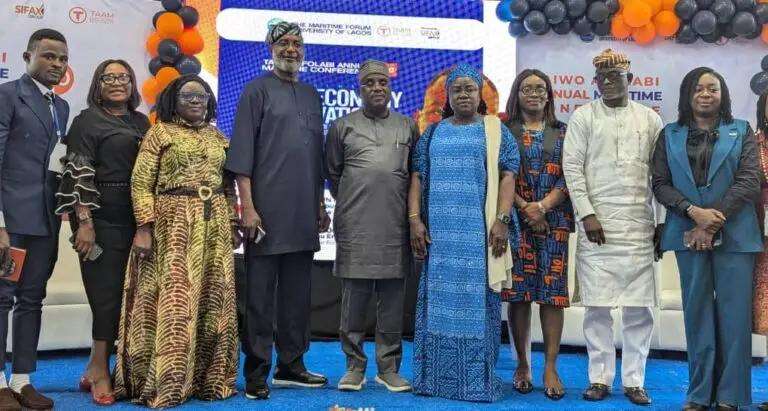
The Minister of Marine and Blue Economy, Mr Adegboyega Oyetola, has unveiled a reform agenda aimed at repositioning the maritime sector for innovation, security, and sustainable growth.
Oyetola unveiled the maritime reforms at the Taiwo Afolabi 7th Annual Maritime Conference (TAAM 7.0) held on Friday at the University of Lagos on Friday.


The News Agency of Nigeria (NAN) reports that this year’s theme, “Blue Economy Innovations: The Sustainable Impact of Infrastructure Development and Modernisation in Maritime”.
The maritime reform is to ensure the overhauling of critical port infrastructure, drive digital transformation, and entrench environmentally responsible practices across the industry.
Oyetola, presented by the Director of Maritime Services of the Ministry, Dr Mercy Ilori, described the establishment of the Marine and Blue Economy Ministry as a deliberate step by the Bola Tinubu administration.
He said that the establishment of the ministry aimed at harnessing Nigeria’s vast coastal and marine assets for national development.
Oyetola noted that the Federal Executive Council had approved a National Policy on Marine and Blue Economy to serve as the strategic framework for unlocking opportunities in ports, fisheries, marine biotechnology, ocean governance, renewable energy, coastal tourism, and climate resilience.
“We are not just building infrastructure; we are building the future.
“Innovation must drive Nigeria’s approach to port rehabilitation, environmental safeguards, service delivery, and industry partnerships,” Oyetola said.
The minister said that the Federal Government had begun an aggressive rehabilitation of critical port infrastructure.
“We are advancing the Western Ports Rehabilitation Programme, including the reconstruction of Apapa and Tin Can Island Ports.
“Procurement processes are ongoing for the rehabilitation of the Eastern Ports,” he added.
Oyetola explained that the physical upgrades were being matched with digital initiatives such as the Port Community System and the One-Stop-Shop platform, which were already improving operational efficiency and reducing cargo delays.
On shipping development, the minister noted of the government’s commitment to reviving the National Carrier through a public-private partnership.
He also said that the long-delayed Cabotage Vessel Financing Fund (CVFF) would soon be disbursed to indigenous operators to boost local shipping capacity.
According to him, the ministry’s digitalisation push across its agencies is already yielding tangible results in revenue generation, transparency, and service efficiency.
He further explained that infrastructure growth would not come at the expense of the environment, adding that the ministry was prioritising sustainable, energy-efficient port development.
Oyetola said that government was making deliberate efforts to cut carbon emissions, reduce waste, and encourage recycling across the maritime value chain.
As part of Nigeria’s bid to shape global maritime policies, Oyetola disclosed that the country had formally launched its campaign to secure a Category “C” seat on the International Maritime Organization (IMO) Council.
Speaking earlier, the Chairman of SIFAX Group and convener of the conference, Dr Taiwo Afolabi, called for urgent investment in modern, resilient, and sustainable infrastructure to unlock the untapped potential of the blue economy.
Afolabi who was represented by the Group Coordinating Director, SIFAX Group, Mrs Wunmi Jegede, said that Nigeria’s vast coastline could become a catalyst for job creation, port competitiveness, and foreign investment if properly harnessed.
Afolabi said that the key objective of this annual conference was to create an intelligent and knowledge-driven platform that would bridge the gap between the industry and the ivory tower.
“We wanted students to see what lies beyond their textbooks, to ask bold questions, and to connect directly with those shaping policy and driving change.
“I am proud that today this vision continues to grow, and that this platform has become one of the most respected gatherings for maritime discourse in any Nigerian university.
“Nigeria’s blue economy is a sleeping giant. We have untapped potential along our vast coastline that, if harnessed responsibly, can create new jobs, strengthen our ports, attract investments, and safeguard our environment for future generations,” Afolabi said.
In her keynote address, Mrs Jean-Chiazor Anishere, (SAN), Vice President Port Consultative Council (PCC), underscored the need for smart, green, and inclusive port systems as critical drivers for the sustainable growth of the maritime sector.
Anishere, who was represented by a maritime lawyer, Mrs Gloria Kanabe, emphasised that the blue economy must go beyond economic growth to ensure environmental protection and regional connectivity.
She urged students and young professionals to see themselves as architects of a sustainable maritime future, calling on them to embrace innovation, leadership, and cross-sector collaboration.
“The oceans we build on must be the oceans we protect.
“Our choices in infrastructure and development will determine whether we harness their potential wisely or irreversibly damage them,”Anishere said.
The Deen of Faculty of Law, University of Lagos, Prof. Abiola Sanni, commended Dr Afolabi for recognising the way to shape the future of the youths.
He said that the conference had grown into one of the most respected intellectual platforms for maritime discourse in Nigeria, bridging the gap between students and industry stakeholders.
Sanni sought internship opportunities for their students, to enable them spend some times in bridging the gaps between theories and practicals.
In his welcome remarks, Mr Enoch Aderounmu, President of the Maritime Forum, University of Lagos, charged youths to see themselves not as future leaders but as leaders of today.
Aderounmu emphasised the urgent need for proactive leadership, ethical responsibility, continuous innovation, and inclusive partnerships across academia, industry, and government.
He highlighted the Maritime Forum’s 10-year journey, which had empowered thousands of students through mentorship, internships, and high-impact programmes, including the Maritime Masterclass, an educational excursion to Lekki Deep Sea Port.
He said that the Taiwo Afolabi Annual Maritime Conference, was a joint collaboration between SIFAX Group and the Maritime Forum of the University of Lagos.
(NAN)