The old wounds of June 12 are bleeding again.
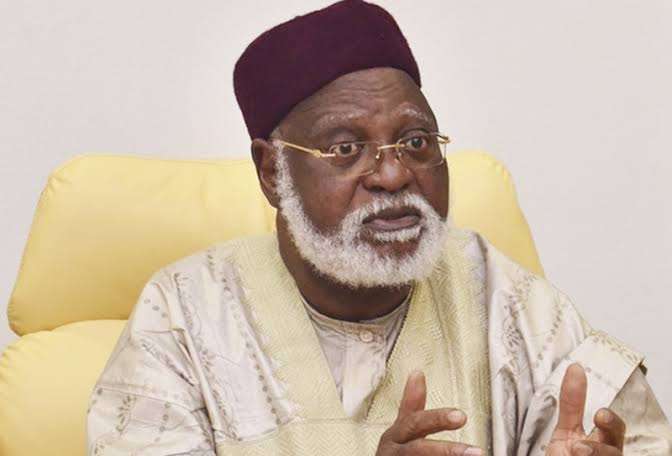
Former Head of State Gen. Abdulsalami Abubakar (retd.) just published “Call of Duty.”
In it, he claims that leaders of NADECO—Nigeria’s fiercest pro-democracy fighters—privately begged him in 1998 to extend military rule.
He also insists MKO Abiola died of natural causes, not poison.




NADECO’s surviving warriors heard it. And they erupted.
—“Which NADECO is he talking about?”—
Col. Tony Nyiam (retd.), one of NADECO’s key voices abroad, threw the book back in outrage.
“I am not sure which NADECO Gen Abdulsalami Abubakar is referring to,” Nyiam told The PUNCH Tuesday.
“To the best of my knowledge, our leader was Chief Anthony Enahoro. His demand was simple: Give Nigeria a people’s constitution first. Not more khaki.”
Nyiam’s voice trembled with decades of memory.
He recalled when Abdulsalami sent an emissary called “Olowu” to London to meet NADECO leaders in exile—including Bola Tinubu, who was then funding the struggle from abroad.
“I travelled from Edinburgh to London for that meeting,” Nyiam said.
“Tinubu gathered all of us. The message was unanimous: No extension. No more dictatorship. Do it right. Do it with a constitution Nigerians agree on. Not the 1999 Constitution imposed by the military.”
He named the men who stood in that room: Enahoro, Gen. Alani Akinrinade, Tinubu, Dr. Kayode Fayemi, Prof. Wole Soyinka.
“Who would ask for more military rule when we were risking our lives to end it? I was shocked when I heard him say so,” Nyiam added. “Either he was misinformed, or he’s being economical with the truth.”
—“Abiola was done away with”—
Then came the harder accusation. Abdulsalami wrote that an autopsy by Nigerian, US, British and Canadian pathologists proved Abiola died of hypertension and heart disease on July 7, 1998. Natural causes.
Nyiam rejected it outright. “I am surprised by his claim that nobody did anything bad to Chief MKO Abiola. From all the evidence we have heard, I doubt his position, with all respect to my senior. Chief MKO Abiola was done away with by those who did not want him to govern.”
He challenged Abdulsalami directly: Name those who betrayed Abiola.
“Those I know who remained committed were Enahoro, Akinrinade, Tinubu—who spent his money—Fayemi, and Soyinka. They can all confirm what we are saying.”
—“He misunderstood us” – Opadokun—
Chief Ayo Opadokun, NADECO’s former General Secretary, said Abdulsalami confused the conversation.
“He was not talking about us in Nigeria. He was referring to NADECO abroad because he sent emissaries to meet them.”
Opadokun insisted NADECO abroad never asked for military extension. Their demand was stability through legitimacy: “We asked him to form a government of national unity to be headed by Chief MKO Abiola. Produce a valid, acceptable constitution before elections. I documented this in the NADECO story.”
He added: “I have received reports from our people abroad that he seems to be misconstruing their discussions with the emissary he sent to them as requesting an extension of military rule, which is not true.”
—The ghost of June 12 rises again—
For Nigerians who lived through 1993–1999, this is more than a dispute over memoirs. It’s about memory, honour, and who gets to write history.
NADECO lost comrades, went into exile, faced assassination. Their fight forced Abdulsalami to hand over power in 1999. Now they say: Don’t rewrite us as beggars for dictatorship. And don’t close the file on Abiola’s death.
Nyiam ended with fire: “The issue was very clear. We wanted a process that would first produce a people’s constitution through a national conference. That could have been achieved within a few months.”
Abdulsalami says one thing. NADECO says another. Between their words lies the truth of June 12—and a nation still searching for it, 33 years later.
-Who betrayed Abiola? Who asked for more military rule?
The veterans are demanding answers. Nigeria is still listening.