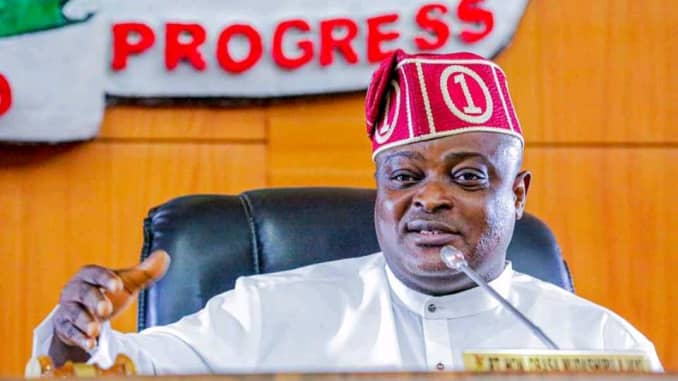
In a country where public service often attracts more condemnation than commendation, the story of Mele Kyari deserves a more thoughtful and balanced reflection than the emotionally charged narratives currently dominating public discourse.
For over five years, Kyari stood at the nerve centre of Nigeria’s most sensitive and politically combustible institution — the Nigerian National Petroleum Corporation, later transformed into the Nigerian National Petroleum Company Limited. To manage the nation’s economic lifeblood in a country as complex as Nigeria is not merely a job; it is a national burden layered with politics, international interests, entrenched cabals, public pressure, subsidy tensions, oil theft crises, and the endless expectations of over 200 million citizens.
Those who now attempt to reduce his stewardship to simplistic accusations deliberately ignore the realities of the office he occupied. No GMD or GCEO of NNPC operates in isolation. The office is deeply tied to government fiscal policy, presidential directives, global oil market shocks, OPEC obligations, subsidy frameworks, and national security considerations. Decisions taken at that level are rarely personal whims; they are products of institutional mandates, national priorities, and collective governmental strategy.
Kyari was, first and foremost, a professional technocrat — a man who spent over three decades climbing through the ranks of the oil industry, not a political adventurer who stumbled into relevance. From his humble beginnings as an Almajiri pupil in Maiduguri to becoming the head of Africa’s largest energy institution, his story remains one of resilience, discipline, humility, and uncommon administrative endurance.



One remarkable attribute that defined his years in office was his calm disposition and respect for institutions. In an era where many public officials often displayed open hostility toward oversight and criticism, Kyari consistently demonstrated restraint and civility in his engagements with the National Assembly and other arms of government. Whether appearing before legislative committees or addressing national concerns, he carried himself with the understanding that institutions must remain stronger than individuals.
That humility mattered.
He understood that leadership at the national level is not sustained by arrogance, but by cooperation, consultation, and institutional respect. Even critics would admit that throughout intense public scrutiny and heated policy debates, Kyari rarely descended into inflammatory rhetoric or political grandstanding. He remained measured, disciplined, and focused on the enormous responsibilities before him.
History will likely remember him less for the noise surrounding his exit and more for the structural transformation he supervised.
Under his watch, the old NNPC — long criticized as a cumbersome state bureaucracy — underwent one of the most consequential reforms in its history. The transition into NNPC Ltd under the Petroleum Industry Act was not cosmetic branding; it was a strategic commercial rebirth intended to reposition the institution as a globally competitive energy company rather than a purely government-dependent corporation.
That transition alone required courage.
Many before him avoided such difficult reforms because reform in Nigeria often creates enemies faster than applause. Yet Kyari stayed the course, helping to steer the organization through institutional restructuring, global energy volatility, the COVID-19 oil market collapse, subsidy controversies, and rising international pressure on fossil-fuel economies.
Importantly too, it was during his tenure and under his supervision that the long-awaited Dangote Refinery eventually came on stream — a milestone many once believed impossible. Regardless of differing opinions surrounding policy decisions and crude supply arrangements, history cannot ignore the fact that the emergence of the refinery represented a major turning point in Nigeria’s downstream petroleum sector.
As the head of the nation’s oil company at that critical period, Kyari played a strategic role in navigating the delicate relationship between national interest, private investment, market realities, and energy security. His professional insights and technical advice on the future of Nigeria’s petroleum industry therefore should not be casually dismissed simply because of changing political winds or public sentiment.
Men who have spent decades inside an industry acquire institutional memory and operational knowledge that remain valuable beyond office tenure. Nations that progress do not discard experience out of emotion; they preserve expertise while improving systems.
Another critical but often overlooked aspect of Kyari’s tenure was his effort to improve transparency within an institution long accused of opacity. For years, one of the loudest criticisms against NNPC was the perceived secrecy surrounding its finances and operations. Under Kyari’s leadership, however, the corporation began taking bold and pragmatic steps toward greater public accountability, including the publication of audited financial statements — something that had rarely been done openly and consistently before his appointment.
That move was significant.
Opening the books of such a sensitive national institution to public scrutiny was not politically convenient, nor was it risk-free. Yet it reflected a recognition that modern national oil companies must increasingly align with global standards of corporate governance, transparency, and accountability. While no institution becomes perfect overnight, the decision to make NNPC’s audited accounts public marked a major shift from the old culture of institutional secrecy that had defined the corporation for decades.
Kyari also championed major gas and upstream initiatives designed to strengthen Nigeria’s long-term energy future. Projects tied to gas expansion, industrial development, and power generation reflected a broader vision that Nigeria’s energy future could not remain solely dependent on crude exports.
Critics are free to interrogate outcomes — that is the essence of democracy — but there is a difference between accountability and orchestrated demonization.
The growing attempt to paint Kyari as the singular architect of every structural failure within Nigeria’s petroleum ecosystem is intellectually dishonest. Nigeria’s oil sector challenges predate him by decades and will most likely outlive several administrations to come. Refineries did not collapse overnight under his leadership. Subsidy distortions did not begin with him. Crude theft networks were not invented during his tenure. These are deeply rooted national problems involving multiple institutions, interests, and power blocs.
For those aggressively demanding that Kyari’s “head be brought,” such calls must not be driven by mischief, political bitterness, or the desperate need to manufacture villains for deeply entrenched national problems. Public service, especially at the level Kyari operated, should not become a theatre where every former official is ritually sacrificed to satisfy public anger or elite rivalries.
At this point, looking for Kyari should be more about drawing from his professional experience, institutional memory, and strategic understanding of Nigeria’s oil and gas architecture than seeking vindictive validation against a man who rendered service under extraordinarily difficult circumstances.
Nigeria needs wisdom more than vengeance.
A country that refuses to learn from its experienced hands risks weakening its own institutions. There is still immense value in the perspective of someone who supervised the transition of NNPC into a limited liability company, managed complex global energy negotiations, navigated subsidy-era pressures, and oversaw one of the most sensitive sectors of the national economy during turbulent times.
What is even more troubling is the atmosphere of vengeance now surrounding former public officials. If every technocrat who accepts difficult national assignments is later subjected to public humiliation, endless suspicion, and politically charged witch-hunts, what message are we sending to the next generation of competent professionals?
Younger, patriotic, highly skilled, and resilient officers are watching.
They are observing whether national service in Nigeria ultimately leads to honour or persecution. They are watching whether courage in implementing unpopular but necessary policies will be rewarded with fairness or repaid with relentless hostility. A nation that consistently discourages its brightest administrators through selective outrage risks creating a future where only the reckless, the desperate, or the opportunistic will be willing to serve.
That is dangerous for governance.
Certainly, institutions must investigate allegations where necessary. Transparency should never be compromised. But justice must never become a substitute for political scapegoating or public entertainment.
Mele Kyari should not be viewed merely through the narrow lens of controversy. He should also be seen as a man who held one of the most difficult offices in Nigeria during one of the country’s most turbulent economic periods — and who, despite enormous pressures, managed to oversee the rebirth, rebranding, and partial modernization of a national oil giant into a commercially oriented limited liability company.
That alone is no small legacy.
At some point, Nigeria must learn to separate genuine accountability from destructive vilification. Nations grow when they build institutions, preserve professional courage, respect experience, and encourage capable hands to step forward — not when they continuously turn former public servants into permanent political prey.