Minister of Education, Dr. Tunji Alausa, has reaffirmed the importance of accurate, comprehensive, and real-time data in driving effective policy formulation, planning, resource allocation, and reforms across Nigeria’s education sector.
The Minister stated this during a review meeting with a delegation from the West African Examinations Council (WAEC), led by the Head of National Office, Dr. Amos Dangut, at his office in Abuja.
Also present were the Permanent Secretary of the Federal Ministry of Education, Dr. Abel Olumuyiwa Enitan, senior ministry officials, and the Vice-Chancellor of Baze University, Professor Abiodun Adeniyi.
Describing reliable data as “the oxygen of modern governance,” Dr. Alausa stressed that meaningful educational reforms can only be achieved through credible evidence and measurable indicators.





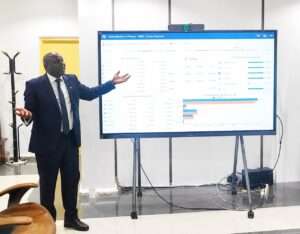
Using the digital education dashboard in his office, he demonstrated how data are being used to identify gaps, monitor trends, and support evidence-based decision-making.
He highlighted the urgent need for accurate information on out-of-school children and other critical indicators, including enrolment and completion rates, teacher deployment, infrastructure, learning outcomes, technical and vocational education, tertiary admissions, graduate employability, educational financing, and school dropout rates.
According to the Minister, the Federal Government’s vision of transforming education into a catalyst for national development depends on an integrated data architecture supported by key agencies such as JAMB, WAEC, NECO, NBTE, NUC, NCCE, UBEC, NABTEB, TRCN, the National Bureau of Statistics, state ministries of education, and tertiary institutions.
He noted that while these institutions generate substantial educational data, the priority is ensuring that such information is accurate, harmonised, timely, and useful for planning. He added that integrated data systems strengthen coordination, accountability, and governance, while fragmented data weakens policy effectiveness.
Dr. Alausa commended WAEC and other examination bodies for generating valuable assessment data that reveal trends in learning outcomes, subject performance, and educational quality.
He urged stakeholders to make greater use of such information in educational planning and reform.
PRNigeria Founder heads to Appeal Court over sismissal of ₦1bn suit against NIPSS*
The Minister also congratulated Dr. Dangut on his forthcoming transition from Head of National Office of WAEC Nigeria to Registrar and Chief Executive Officer of WAEC across the West African sub-region, urging him to champion data quality, examination integrity, and evidence-based educational planning across member countries.
He further emphasised that examination bodies should serve not only as assessment institutions but also as repositories of educational intelligence capable of informing curriculum development, teacher training, infrastructure planning, and human capital development.
He therefore called for stronger collaboration between WAEC and the Federal Ministry of Education in developing integrated educational datasets to support national planning and policy evaluation.
Dr. Alausa maintained that countries that have successfully transformed their education systems did so through robust data systems that enabled them to understand challenges, monitor progress, and evaluate outcomes.
He concluded that data are strategic national assets essential to improving access, quality, accountability, and competitiveness within Nigeria’s education system.