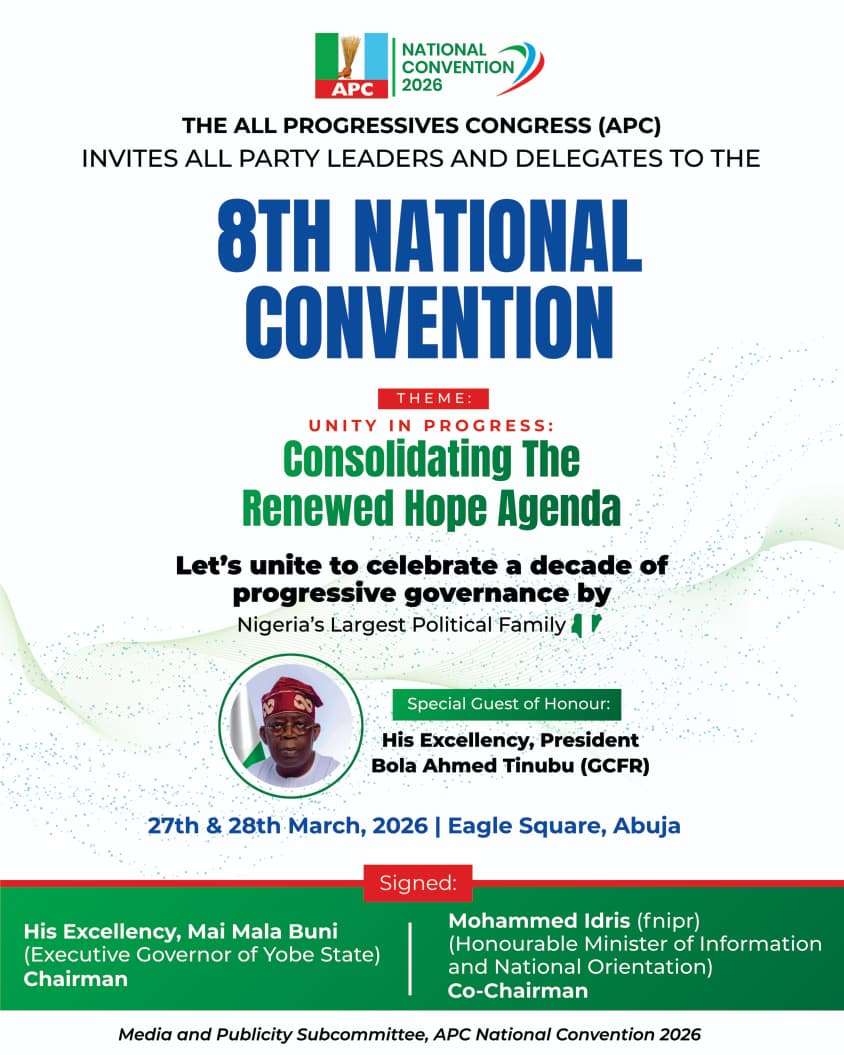
Nigeria stands today at a troubling crossroads—not yet in the darkness of outright dictatorship, but no longer walking confidently in the light of democratic consolidation.
What confronts us is subtler, more insidious: a steady, almost calculated drift toward what political scientists describe as competitive authoritarianism—a system where elections exist, opposition is tolerated in form, but the playing field is so skewed that genuine competition becomes an illusion.
Recent controversies surrounding the Independent National Electoral Commission (INEC) and its handling of internal party disputes—particularly within the The People’s Democratic Party (PDP) and African Democratic Congress (ADC)—have intensified public suspicion.
Where courts appear to counsel restraint and preservation of the status quo, yet administrative actions suggest otherwise, the question ceases to be merely legal. It becomes existential: who guards the neutrality of the electoral umpire? No democracy survives the loss of confidence in its referee.

To be clear, Nigeria has not formally abandoned multiparty democracy. The All Progressives Congress (APC) governs, while the People’s Democratic Party (PDP) , the African Democratic Congress (ADC) and a constellation of smaller parties still exist. But existence is not the same as effectiveness.
A political system in which opposition parties are weakened by internal crises, induced internal crises, elite defections, and administrative pressures begins to resemble not a contest of ideas, but a choreography of inevitability.
This is how dominant-party systems are born—not by decree, but by design and drift.
There is a growing dangerous perception— whether true or not—that the objective is not to win a competitive election in 2027, but to preempt it.
When institutions that should arbitrate fairness are themselves drawn into controversy, when opposition platforms appear fragmented or co-opted, and when political alignments increasingly converge toward the centre of power, elections risk becoming ceremonial rather than consequential.
It is at this point that the ghost of Sani Abacha is invoked. The comparison may be imperfect but provocative. Under Abacha, political pluralism was not merely weakened; it was extinguished. Parties were manufactured, dissent was crushed, and the absurdity of five parties adopting a single candidate became the defining symbol of authoritarian farce.
Nigeria is not there—yet. But the danger lies precisely in the distance between not there and not far. What we are witnessing is not the abrupt imposition of tyranny, but the gradual normalization of imbalance.
Courts still sit. Journalists still write. Politicians still campaign. Yet beneath these democratic rituals, the substance begins to thin. This is the essence of competitive authoritarianism: democracy in structure, but not in spirit.
The consequences, if unchecked, are profound. First comes the erosion of trust in Independent National Electoral Commission (INEC)—the very institution upon which electoral legitimacy rests. Once citizens begin to believe that outcomes are predetermined, participation declines, cynicism deepens, and democracy becomes performative.
Second is the slow suffocation of opposition. A democracy without a viable opposition is not a democracy—it is an echo chamber. When parties become indistinguishable or dependent, governance loses its most essential restraint: accountability.
Third is the emergence of elite cartelization, where politics becomes less about public service and more about negotiated inclusion within a shrinking circle of power. The people, in whose name democracy is supposedly practiced, are reduced to spectators.
In this context, calls for a boycott of the 2027 elections, though emotionally satisfying, are strategically flawed. Boycotts may delegitimize elections; but they consolidate power. To withdraw from the arena is to concede it entirely. This is the trap. A clear dilemma.
If democracy is being hollowed out, the solution cannot be abandonment. It must be resistance—legal, political, and civic.
Nigeria must resist the temptation of quiet resignation. The judiciary must assert its authority without fear or favour.
Political parties must fight on. Civil society must remain vigilant, not episodic. And above all, Bola Ahmed Tinubu, as the foremost beneficiary of the current order, bears a historic responsibility: to ensure that his tenure is not remembered as the moment Nigeria chose control over competition.
History is unforgiving to those who confuse dominance with legitimacy.
The cost of elections may rise to nearly trillions of naira by 2027, but the cost of a hollow democracy is far greater. Nations decay through the quiet corrosion of their institutions.
Nigeria is still a democracy.
But it is a democracy under pressure—walking, steadily and perhaps unknowingly, towards a place where elections remain, but choice disappears.
The time to halt that journey is now.
■ Professor Ukertor Gabriel Moti ( Professor of Public Sector Management and Governance).
Stay ahead with the latest updates! Join The ConclaveNG on WhatsApp and Telegram for real-time news alerts, breaking stories, and exclusive content delivered straight to your phone. Don’t miss a headline — subscribe now!