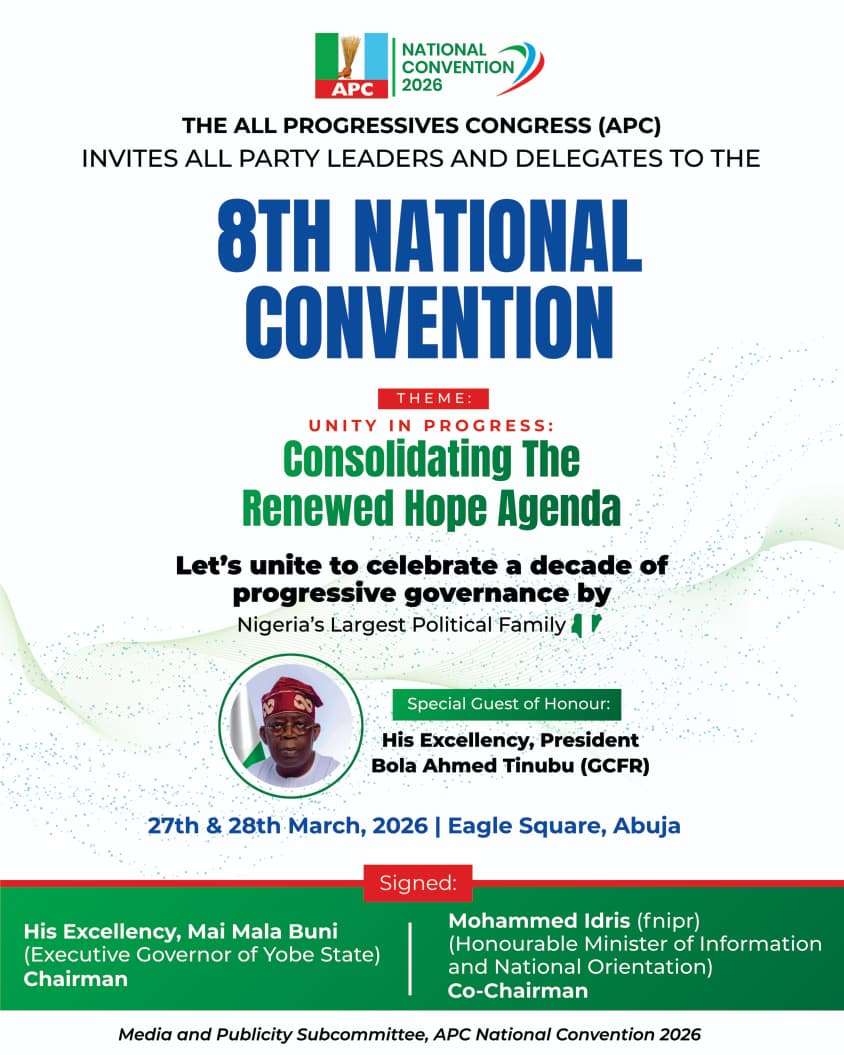
With Governor Seyi Makinde of Oyo State invoking ‘Operation Wet ẹ’ at the Ibadan gathering of the ‘Participating Opposition Parties in Nigeria’ (we can also help them by adding the acronym, POPN), Nigerians do not need anyone to tell them that another desperate season is already upon us. Makinde warned the ruling All Progressives Congress (APC) not to play pranks with the 2027 general election. But as reckless as his statement may be, what I find interesting is that the ‘rig and roast’ apostles of yesterday are now worried that others are pledging to deploy the same ‘petrol protocol’ against their own government. The armour bearer, as the Yoruba people would say, never likes anybody to come within his vicinity with a matchet in hand!
Just 12 years ago, during his investiture as Chancellor of the Ladoke Akintola University of Technology, Ogbomosho, Oyo State, a certain Bola Tinubu threatened the administration of President Goodluck Jonathan with fire and brimstone. “They are already planning to rig the elections but be ready to protect your votes; nobody serves you freedom a la carte. It is going to be rig and roast,” Tinubu (who is now our president) had declared in June 2014 ahead of the gubernatorial elections in Ekiti and Osun States that preceded the 2015 general election. “We are prepared not to go to court but to drive you out. We will not take it anymore. If you mess up in Ekiti and Osun states, you will see our reactions. For every action, there must be a reaction.”
Having studied the psychology of Nigerian voters, politicians who seek to ‘rescue’ our country at every election season always campaign on threats against those they seek to displace rather than offer hope to the people. For instance, beyond Makinde’s declaration, the POPN statement signed by my brother, Bolaji Abdullahi, is all about scaremongering and the self-deceiving pledge to field only one presidential candidate against Tinubu next year. As an aside, I heaved a sigh of relief last night when I learnt the Supreme Court will deliver judgment today in a pending appeal on the leadership (ownership) crisis in the main opposition African Democratic Congress (ADC).
When the case was heard expeditiously by the apex court on 22 April, expectations were that the judgement would follow immediately, considering the urgency. The delay, especially for a court that can rule and explain later, has already created unhelpful speculations. Who wins or loses on this matter is not my business but to withhold judgment for more days under the current political circumstance would have been very damaging not only for the judiciary in Nigeria but also for our democracy and the rule of law. Meanwhile, as we enter the election season, the focus of this column will be increasingly political in the coming weeks. My main concern today is that rather than campaign on issues that advance the public good, the stock-in-trade of our politicians is usually to embark on all kinds of gimmickry. Though some are more subtle than others.


The Zamfara State government recently sponsored the mass wedding of over 100 couples drawn from what officials describe as “vulnerable groups” across 14 local councils. Not to be outdone, the Kano State government has announced that it is also finalising arrangements for a mass wedding of 1,500 couples under its social welfare initiative, quaintly branded ‘Auren Gata’. For those counting, that is 1,600 couples whose marriages are being bankrolled by government in these two states. And if you add the 1,000 couples that Katsina is also preparing to wed, we are looking at over 2,600 state-sponsored marriages across just three states in the North-West. The timing of this ‘programme’ as we approach the election season suggests that it is a vote-catching gambit. But this is an issue with far-reaching implications that we ignore to our peril.
Now, let me be clear. I have nothing against marriage. It is a beautiful institution. But when governments that cannot generate the revenue to pay their workers’ salaries begin to appropriate public money to pay dowries for those who, by their own admission, cannot fend for themselves, we must pause and ask what exactly we are doing as a country. What is the logic? How can a man who cannot afford to pay his own bride price of N200,000 somehow going to be able to raise a family? Or a woman who needs N50,000 from the government to start ‘small-scale trading’ in her matrimonial home is now equipped for the responsibilities of wifehood and, inevitably, motherhood?
But it is the distribution of the money that truly tells the story. In Zamfara, each groom received N200,000 for dowry payments, while each bride got N50,000 for what the government calls ‘empowerment’. Let us do the arithmetic. That is N250,000 per couple. Of this amount, N200,000, a full 80 percent, goes to the ceremony itself. The ‘empowerment’ component, the part that is supposed to give these young people a fighting chance at economic survival, is a mere N50,000. That is 20 percent. If you wanted a metaphor for how government works in this country, you could not design a better one. Eighty percent recurrent, 20 percent capital. Eighty percent consumption, 20 percent investment. Eighty percent pageantry, 20 percent productivity. It is the Nigerian budget philosophy in microcosm: Spend lavishly on what is consumed today, and throw crumbs at what might build tomorrow.
This is not a new phenomenon, of course. The Kano State government under Abdullahi Ganduje spent over N300 million on a similar mass wedding for 1,500 couples back in 2019. That initiative was also described as a social welfare programme aimed at “reducing the problems associated with the high number of unmarried youth.” What happened to those 1,500 couples? How many of those marriages survived? How many of those brides ended up as statistics in the divorce courts or, worse, in the cycle of poverty they were supposedly being rescued from? And what about the children produced from such unions? Nobody tracks these outcomes because the programme was about optics, and governors playing Father Christmas with public funds, while the real problems of governance go unaddressed.
Let us talk about those real problems, beginning with the fiscal elephant in the room: Internally Generated Revenue (IGR). According to the National Bureau of Statistics (NBS), Kano State, with its five major markets and a population of over 13 million, generated N37.38 billion in IGR in 2023. In fact, the entire North-West zone, all seven states combined, generated N206 billion in IGR in 2023. Zamfara’s situation is even more dire. The state generated just N22.16 billion in IGR in 2023, up from a dismal N6.51 billion the previous year. Its 2024 figure was approximately N25.5 billion. Meanwhile, Zamfara budgeted N546 billion in expenditure for 2025, with only N32 billion expected from IGR. That is barely 5.8 percent of its budget. The state cannot even pay its workers’ salaries from what it generates internally. Its budgeted personnel cost of N58.3 billion is nearly double its IGR target. The same applies to Kano, where the budgeted personnel expenditure of N150.9 billion far exceeds the IGR target of N85.8 billion.
So, what are these states spending? Monthly allocations from the Federation Account of course. These are states that are essentially wards of the federation, surviving on handouts from the centre. And yet they find the resources to sponsor mass weddings. The priorities could not be more perverse. Meanwhile, the hundreds of millions of Naira being expended on this programme could have been invested in vocational training centres, small business incubators, agricultural mechanisation, or any number of productive ventures that might give these young people a real shot at self-sufficiency. Instead, we are paying for their weddings.
The entire thing tells the story of a country where productivity is not even part of the conversation. This, as I once argued, perhaps explains why the metaphors with which we conceptualize Nigeria relate to opportunistic and irresponsible consumption: sharing formula, allocation, national cake, etc.But how can wedding ceremony be a solution to poverty, unemployment, and social dislocation? A marriage does not feed, create jobs or build skills for anybody. What marriage does, in the absence of economic capacity, is multiply the number of mouths to feed.
The Governor of Zamfara, Dauda Lawal, who served as “father” to each groom at the ceremony, urged the brides to “be obedient to their husbands.” With all due respect, what these young people need is not a lecture on matrimonial obedience. What they need are skills, an economy that works and a government that invests in their productive capacity. A governor that pays for your wedding but cannot provide you with a means of livelihood has not done you a favour. He has merely set a trap. In the case of Kano, the revenue service has acknowledged that its five international markets and massive commercial potential should be generating at least N300 billion per annum in internal revenue. But they are generating barely a quarter of that. Rather than channel energy and resources into closing that gap, building the administrative capacity to collect taxes, and creating the economic conditions that generate taxable activity, the priority is to sponsor mass weddings.
I know some people will try and turn this into another ethnic issue but they will be missing the point completely. This is about the misplaced priorities that now define governance in Nigeria. If a young man cannot afford a bride price of N200,000, the answer is not for the government to pay it for him. The answer is for the government to create the conditions under which he can earn it himself. You do not solve the problem of poverty by subsidising its symptoms. You solve it by attacking its causes.
In 2009, there was a report on Nigeria sponsored by the British Council and coordinated by David Bloom, Harvard Professor of Economics and Demography on the diversity of our population. Some of the warnings in the research, on which several academics and Nigerian professionals at home and in the Diaspora collaborated, are already with us: “Cities that are increasingly unable to cope with the pressures placed on them; ethnic and religious conflict and radicalisation; and a political system discredited by its failure to improve lives.” Titled ‘Nigeria-The Next Generation’, the report predicted that by 2030, Nigeria will be one of the few countries in the world with an abundance of young people in which case youth, not oil, will be the country’s most valuable resource. The same report, however, warned that “if Nigeria fails to collect its demographic dividend, the seriousness of the country’s predicament should not be underestimated. Its prospects will be bleak and could be catastrophic.”
We are already seeing this in the collapse of the educational system and the security crisis that has turned vast expanse of our country into a theatre of violent insurgency and banditry. Therefore, organising periodic wedding ceremonies for ‘vulnerable’ young people may earn momentary applause and win votes for the governors concerned but they are creating long-term harm to our society. I hope they understand that.
Assassins in Police Uniform
That those saddled with the responsibility of protecting Nigerians are beginning to behave like assassins is a troubling challenge the Acting Inspector General of Police (IGP), Mr Muhammad Adamu has decided to confront. Henceforth, electro-muscular disruption technology known as taser will replace the use of firearms for routine patrols, arrest duties and other low-risk operations. This, according to Adamu, is a “strategic approach towards reducing incidents of fatalities associated with misappropriation of lethal weapons by the Police as first line of response to any threat.”
I am almost certain the order will soon be frustrated and rescinded. But that it was made at all is a commendable gesture, given the recent spike in the number of extra judicial killings by policemen. “Lagos State has recorded four incidents of misuse of firearms which have resulted in extrajudicial killings of young citizens of this country and injury to others” said Adamu who added that it is “worrisome that two of these incidents occurred within the last two weeks. Aside negating our professional calling, extrajudicial acts of any description or level by any police personnel is an unacceptable anomaly that creates distrust and disdain between the citizens and the police and widens the trust gap between them.”
=============================
I wrote the foregoing seven years ago in my 18th April 2019 column, The Assassins in Police Uniform – THISDAYLIVE, where I catalogued several cases of extrajudicial execution by some rogue personnel of the police. Despite the pledge by then IGP Adamu who is now seeking the APC gubernatorial ticket for Nasarawa State that seems more like a pie in the sky, nothing has changed. Last Sunday in Effurun, Delta State, a 28-year-old music artist, Oghenemine Mena was summarily executed by a policeman who has now been arrested. The details are too gory to be recounted here.
That this is a familiar tragedy is why we should all be concerned. Incidentally, even before the ‘EndSARS’ protest of October 2020, I had written several columns on this menace. In a memorable one, Let Me Talk to my Father Before I Die – THISDAYLIVE, I recounted the ordeal, captured in a trending video, of a young man who had been shot by the police and dumped in a Toyota Hilux: “…Sensing that his life is ebbing away, he makes a desperate plea: ‘Let me talk to my father before I die’. It is met with a stern ‘God punish your father!’ by one policeman and a cacophony of curses and abuses from bystanders…”
While I commiserate with the family of Mena and join in the demand for justice, authorities in the country must use this case to send a strong message. When policemen can routinely supervise the extra judicial killing of innocent citizens they are paid to protect, the net result is a collective descent into a Hobbesian jungle where life is nasty, brutish and short. I know those who would argue that we are already there!
• You can follow me on my X (formerly Twitter) handle, @Olusegunverdict and on www.olusegunadeniyi.com
Stay ahead with the latest updates! Join The ConclaveNG on WhatsApp and Telegram for real-time news alerts, breaking stories, and exclusive content delivered straight to your phone. Don’t miss a headline — subscribe now!